
This question keeps coming up because follow for follow sits in a gray zone: widely practiced, rarely banned outright, and often misunderstood.
Short answer: Yes, follow for follow is technically allowed on all three platforms.
Long answer: scaling it is where effectiveness and safety break down.
None of these platforms prohibit mutual following as a concept. Social networks are built on reciprocal connections. What they restrict is not reciprocity—but behavioral abuse.
Is Follow for Follow Against the Terms of Service?
Across Instagram, TikTok, and Twitter (X), the act of following someone and receiving a follow back does not violate Terms of Service on its own.
Platforms cannot and do not ban reciprocity as a concept. Mutual following is a normal social behavior. Friends follow each other. Peers connect. Communities grow through reciprocal links. If this were illegal, social networks would collapse under their own rules.
Where problems begin is not the action, but the pattern created when follow for follow is scaled.
Modern platforms enforce policies indirectly through behavioral thresholds rather than explicit prohibitions. Instead of saying “follow for follow is banned,” they define limits around actions that tend to accompany it when people try to systemize the tactic.
The most common red flags are:
Rapid or excessive following actions
When an account follows far more users than a normal human would in a short time window, it signals automation or growth manipulation. Even if each follow is technically allowed, the velocity is not.
Repetitive follow–unfollow cycles
Unfollowing large numbers of users shortly after following them creates a clear pattern of artificial growth. Platforms track these cycles because they indicate intent to extract numbers rather than build relationships.
Automation that produces non-human timing or volume
Actions that occur at perfectly spaced intervals, at all hours, or at volumes inconsistent with normal usage are easy to detect. This isn’t about automation itself—it’s about automation that removes human variability.
Engagement that collapses immediately after the follow
This is the most overlooked signal. When large numbers of new followers consistently ignore content after connecting, the system flags the relationship as low-quality. No rule is broken, but trust erodes.
This is why so many creators say, “I didn’t break any rules, but my reach dropped.”
They’re usually right.
Nothing in their account history shows a violation. No warning is issued. No restriction is applied. From a policy standpoint, everything looks clean.
What changed is algorithmic confidence.
The system tested their content with the audience they built and received weak responses. Based on that data, it adjusted future distribution. That adjustment feels like punishment, but it’s actually optimization.
The platform didn’t penalize the account.
It stopped trusting the audience.
This is the critical distinction most creators miss: Terms of Service govern what you’re allowed to do. Algorithms govern what they’re willing to reward.
Follow for follow often stays within the rules while simultaneously training the system to expect disengagement. And once that expectation is set, reach becomes harder to earn—without any rule ever being broken.
Instagram: Is Follow for Follow Allowed?
On Instagram, mutual following is completely normal human behavior.
Friends follow each other. Creators connect with peers. Communities grow through reciprocal links. Instagram cannot—and does not—penalize accounts simply because a follow is returned.
What Instagram monitors is not the follow itself, but the quality of the relationship that follows.
Instagram’s ranking systems are built around post-follow behavior. Every follow is treated as a soft signal—an assumption that this user might be interested in future content. That assumption must be confirmed through actions.
After a follow, Instagram watches closely:
Does engagement continue or disappear?
If a new follower interacts once and then never again, the system downgrades the strength of that connection.
Do new followers watch, save, reply, or return?
Likes alone carry limited weight. Instagram prioritizes deeper signals like watch time on Reels, saves, replies, profile taps, and repeat interactions across multiple posts.
Does reach per post improve or degrade over time?
If content performs worse as follower count increases, Instagram learns that the audience is misaligned. Reach doesn’t collapse instantly—it tightens gradually.
When follow for follow generates large numbers of followers who consistently ignore content, Instagram’s ranking systems adjust accordingly. The platform doesn’t need to apply penalties or restrictions. It simply becomes more conservative about distribution.
This is why follow for follow often feels safe at first and ineffective later.
Yes—follow for follow is allowed on Instagram.
But at scale, it often teaches Instagram the wrong lesson about who your content is for.
Instead of signaling relevance, it signals uncertainty.
And in an ecosystem where distribution is earned through confidence, uncertainty quietly reduces reach.
TikTok: Is Follow for Follow Allowed?
Yes—follow for follow is allowed on TikTok.
But TikTok is also the platform where follow for follow matters the least.
Unlike Instagram or Twitter (X), TikTok does not use the follower graph as the primary driver of distribution. The For You Page is built almost entirely on behavioral testing. Each video is treated as an independent unit, evaluated on how viewers respond—not on how many followers the creator has.
TikTok’s core signals are:
Watch time
How long viewers stay with the video.
Completion rate
Whether they finish it—or drop off early.
Replays
Whether viewers watch again, intentionally or passively.
Repeated exposure behavior
Do users watch multiple videos from the same creator over time?
Follow for follow contributes almost nothing to these signals.
A reciprocal follow does not guarantee that the video will be watched. It does not increase completion rate. It does not create replays. If anything, it often introduces viewers who are less likely to watch through, because the follow was not driven by content interest.
TikTok allows reciprocal follows because they are socially normal. But the algorithm largely ignores them unless behavior confirms interest afterward.
This is why follow for follow on TikTok produces such confusing results.
Creators can accumulate thousands of followers and still see wildly inconsistent—or flat—views. One video may explode while the next dies instantly. The follower count looks impressive, but it doesn’t stabilize distribution.
From TikTok’s perspective, this makes sense.
Followers are not the signal.
Behavior is.
If follow for follow does not lead to sustained viewing behavior, it is functionally invisible to the system. It isn’t punished. It simply isn’t rewarded.
On TikTok, follow for follow doesn’t hurt as loudly as it does on other platforms—but it doesn’t help either.
Twitter (X): Is Follow for Follow Allowed?
On Twitter (X), follow for follow is not only allowed—it’s culturally common.
Creators, founders, traders, and builders follow each other constantly. Mutual follows are part of how Twitter conversations form. There is nothing inherently suspicious about follow-back behavior on this platform.
Where things break down is at the algorithmic level.
Twitter’s ranking systems do not reward passive connections. They reward interaction density—how often accounts meaningfully interact with each other over time.
The signals Twitter (X) prioritizes most include:
Replies and reply depth
Not just whether a tweet receives replies, but whether those replies turn into conversations.
Retweets and quote tweets
Especially when they come from accounts with overlapping interests or audiences.
Profile clicks and session time
Whether users click through, read more tweets, and stay on the platform.
Repeated interaction between accounts
Ongoing exchanges matter far more than one-off actions.
A follow without interaction contributes almost nothing to these signals.
When follow for follow is scaled, it creates a large follower base with minimal interaction overlap. Tweets are delivered to timelines where users scroll past without replying, retweeting, or engaging. Over time, this dilutes engagement density.
The result is not punishment—it’s invisibility.
Mass follow for follow often leads to:
Low interaction density
Many followers, few conversations.
Timeline dilution
Tweets appear to people with no contextual interest, increasing skip rates.
Weak post-level engagement
Replies and retweets fail to compound across posts.
Twitter does not need to ban follow for follow to neutralize it. Accounts with large but inactive follower bases simply stop surfacing consistently in timelines, search, and recommendation modules.
So yes—follow for follow is allowed on Twitter (X). But as a growth system, it’s fragile.
It scales numbers faster than it scales conversations. And on Twitter, conversations are the algorithm.
“Banned for Follow for Follow” — What Actually Happens?
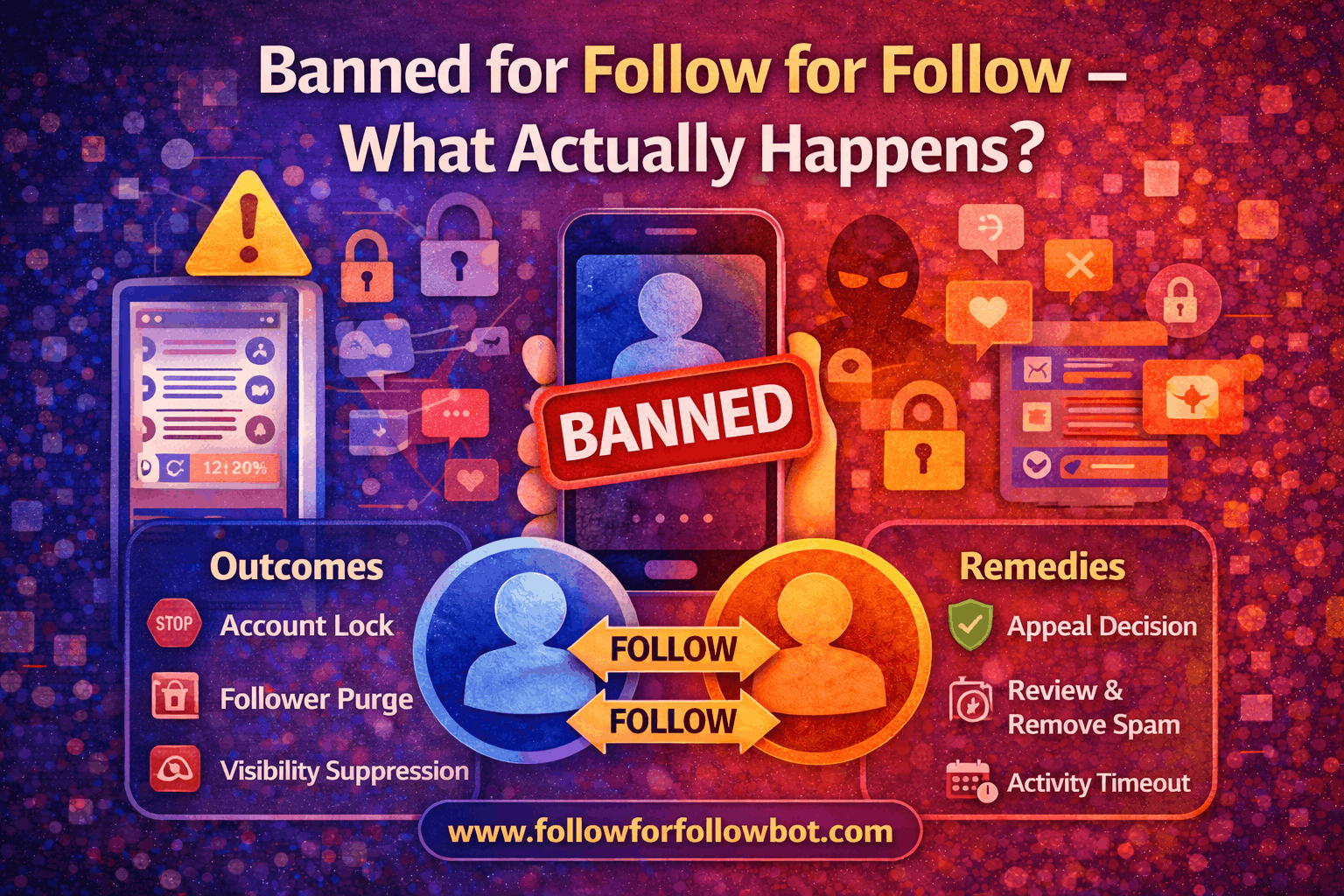
When creators say they were “banned” or restricted for follow for follow, the reciprocal follow itself is almost never the cause.
Platforms do not enforce rules at the level of individual social actions. Following someone and receiving a follow back is normal behavior. If that alone triggered bans, massive portions of the user base would be affected.
What actually triggers enforcement is behavioral abuse at scale.
In nearly every case, the restriction comes from one of these patterns:
Aggressive automation
Tools that execute actions too quickly, too consistently, or without human variability create obvious machine-like signatures. Platforms don’t need to guess intent—they see timing, volume, and repetition.
Excessive action rates
Following, unfollowing, liking, or commenting far beyond normal usage thresholds signals growth manipulation. Even if each action is technically allowed, the frequency is not.
Repetitive follow–unfollow scripts
Cycling large numbers of follows and unfollows is one of the clearest indicators of artificial growth. These patterns are easy to detect and heavily associated with spam behavior.
Low-quality tools with obvious footprints
Cheap or outdated tools often reuse IPs, repeat timing patterns, or lack proper pacing. Accounts don’t get restricted because they used a tool—they get restricted because the tool left fingerprints.
This is why enforcement feels sudden and confusing.
From the creator’s perspective, nothing changed—they were “just doing follow for follow.” From the platform’s perspective, a behavioral threshold was crossed.
The enforcement is not about reciprocity.
It’s about abuse patterns.
This misunderstanding is what causes creators to repeat the same mistake with different tools. They abandon one method, switch platforms or software, and run the same strategy again—only to hit the same wall.
We break this cycle down in depth in the main follow for follow pillar guide, because the real risk isn’t breaking rules—it’s training systems to recognize your behavior as low-quality.
Follow for follow doesn’t get accounts banned.
Bad scaling logic does.
And in 2026, platforms are extremely good at telling the difference.
The Real Rule Across All Platforms
Across every major social platform in 2026, follow for follow exists in a strange gray zone. It is not explicitly forbidden, and it is not explicitly encouraged. That ambiguity is what keeps the tactic alive.
The mistake most creators make is assuming platforms judge actions in isolation. They don’t. Modern systems almost never ask, “Was this action allowed?” They ask something far more important: “What happened after the action?”
A follow is not a reward. It is a hypothesis.
From the algorithm’s perspective, every new follow represents a question: Is this user actually interested in this content? That question is not answered by the follow itself, but by everything that follows—watch time, saves, replies, repeat interactions, and whether the user comes back voluntarily.
When those behaviors appear, the system gains confidence. It learns that the connection is real, that the audience match is valid, and that the content deserves broader testing. Distribution expands naturally.
When those behaviors don’t appear, the opposite happens. Confidence erodes—not dramatically, not with penalties or warnings, but quietly. The system becomes more conservative. Fewer new users are tested. Weak posts recover more slowly. Growth begins to feel heavier, even though nothing obvious has gone wrong.
This is why follow for follow is so often misunderstood.
Creators focus on the legality of the action. Platforms evaluate the quality of the outcome.
At small scale, this difference barely matters. A handful of irrelevant followers won’t collapse an account. But when follow for follow becomes a system—repeated, scaled, or automated—it creates a pattern of low-confidence connections. Over time, that pattern teaches the algorithm a simple lesson: this account attracts attention without interest.
Once that lesson is learned, everything becomes harder.
Reach doesn’t disappear overnight. Engagement doesn’t vanish instantly. Instead, growth loses momentum. Discovery slows. Every post has to work harder to earn the same exposure it once received.
This is why creators often say they were “never banned” yet still feel invisible. They’re usually telling the truth. No rule was broken. No punishment was applied. Trust was simply withdrawn.
And this rule applies universally—Instagram, TikTok, Twitter (X), and beyond.
Platforms don’t care whether you followed someone back.
They care whether that follow turned into sustained behavior.
If it did, the system rewards it.
If it didn’t, the system remembers.
This is also why follow for follow no longer scales in 2026. Not because it’s immoral or forbidden, but because it fails to generate the signals modern algorithms rely on. Reciprocity ends at the follow. Relevance continues afterward.
If you want the deeper breakdown—why follow for follow once aligned with early algorithms, how that alignment collapsed, and what replaced it—we cover that fully in what follow for follow actually means in 2026.
And if you’re trying to grow without repeating the same trust-eroding patterns, the real challenge isn’t automation itself. It’s where automation is applied. Tools like MP Suite are built around reinforcing interest after discovery, not manufacturing connections before it—because in 2026, relevance isn’t something you can trade. It’s something the system has to see proven.
Where Tools Fit (And Where They Don’t)?
Tools don’t get accounts restricted. Bad growth logic does.
This distinction matters, because most debates around automation are framed incorrectly. Platforms are not reacting to the presence of tools. They are reacting to the patterns those tools create.
When automation is used to manufacture activity—mass follows, artificial reciprocity, empty engagement—it produces predictable signals: brief spikes followed by silence. Those patterns teach the algorithm that interactions are superficial, not sustained. Over time, trust erodes, and distribution tightens. No violation is needed. The system simply adapts.
This is why MP Suite was never built to automate follow-for-follow loops.
Follow for follow fails not because it’s automated, but because it tries to replace relevance with obligation. Automation doesn’t fix that problem. It magnifies it.
Where tools do fit is after relevance has already been demonstrated—after discovery, after interest, after an audience signal exists. At that stage, automation isn’t creating demand. It’s reinforcing it. It helps creators respond consistently, nurture interaction, and confirm the signals platforms are already looking for.
That difference is critical.
Automation that amplifies intent aligns with platform incentives and stays safe. Automation that manufactures numbers works against them and quietly loses leverage.
Conclusion
Follow for follow can still inflate visible numbers, but it no longer builds reach. Platforms don’t reward reciprocal actions; they reward what happens after the follow. When new followers don’t engage, distribution tightens quietly.
That’s where MP Suite fits. Instead of automating follow-for-follow loops, MP Suite reinforces engagement after relevance is demonstrated—helping algorithms see alignment instead of noise. Numbers can be manufactured. Trust cannot.