
Follow for follow keeps coming back for one simple reason: when growth feels slow, creators look for actions that produce visible movement. Following someone and seeing numbers change feels better than posting content and waiting.
But “smart follow for follow” is often misunderstood. Most creators are not asking how to abuse the tactic harder. They are asking how to avoid killing their reach while still getting some early momentum.
This article explains what “doing follow for follow the smart way” actually means, where it can make sense in limited cases, where it breaks down completely, and what replaces it once growth needs to scale. This builds directly on the concepts explained in the Follow for Follow Guide, and reframes follow for follow as a boundary tactic, not a growth system.
What People Usually Mean by “Smart” Follow for Follow?
When creators say they want to do follow for follow “the smart way,” they usually mean one of three things:
- Avoid getting restricted or flagged
- Avoid destroying engagement
- Avoid wasting time on useless followers
Very few people are trying to optimize follow for follow for quality. Most are trying to reduce the damage while still getting short-term relief.
This is why advice around “smart F4F” often focuses on limits, pacing, or stealth. Follow fewer people. Do it manually. Spread actions out. Avoid obvious automation.
Those tips can reduce risk, but they do not change the core issue. They only slow it down.
When Follow for Follow Can Make Sense (Limited Scenarios)
There are narrow situations where follow-back behavior is natural and relatively harmless, but they look very different from what most people think of as follow for follow.
What makes these scenarios safe is not the follow itself. It is the order of events. Relevance exists before the connection.
In small, tightly defined niches, creators often see the same accounts repeatedly. They comment on each other’s posts, reply to stories, share similar audiences, or reference the same topics. By the time a follow happens, the platform has already observed interaction, attention, and return behavior. The follow simply formalizes an existing relationship.
This is also common in early-stage peer networking. New creators in the same space may interact consistently as they learn and grow together. The follow is not an attempt to manufacture growth. It is a signal that both sides recognize mutual relevance.
In these cases, follow-back behavior has several defining characteristics:
- Engagement happens before the follow, not after
- Volume stays low and fully manual
- There is no expectation that this will scale
- No follow–unfollow cycles are used
- Content continues to be engaged with after the follow
Because interaction already exists, the algorithm does not see a cold connection. It sees continuity. The follow reinforces a signal that is already validated.
This is why, in these limited scenarios, follow for follow is not a strategy at all. It is social confirmation. Growth still comes from content performance and engagement, not from the act of following.
The moment this behavior becomes intentional, repeatable, or volume-driven, the order flips. Follows come first. Engagement becomes optional. Relevance is assumed instead of proven.
At that point, the system stops interpreting the connection as meaningful. What was once harmless networking turns into audience mismatch, and the same mechanism that once felt safe begins to quietly damage reach.
Rules That Reduce Damage (But Do Not Make It Safe)
When creators insist on using follow for follow, the conversation usually shifts from effectiveness to damage control. The goal is no longer to grow faster, but to avoid triggering obvious negative consequences too quickly.
These rules exist for one reason: to make follow-back behavior look more human and less extractive. They do not improve signal quality. They only slow down how fast the system learns that the audience is mismatched.
Noted patterns that reduce damage (but not risk):
- Very low daily volume
Small numbers reduce pattern detection and keep behavior closer to normal social use. High volume accelerates audience mismatch and trust loss. - Manual actions only
Manual pacing avoids mechanical timing and obvious automation footprints, but it does not change why the follow happened. - No follow–unfollow cycles
Unfollowing after a short window is one of the fastest ways to destroy trust signals. Avoiding it reduces visible abuse, not underlying irrelevance. - Measuring engagement after the follow
This is the only rule that aligns slightly with platform logic. If engagement does not follow, the connection has no value. - Stopping immediately when engagement drops
Continuing once signals weaken compounds the damage. Most creators ignore this and push volume instead.
What creators often believe will help, but doesn’t:
- Scaling slowly instead of fast
- Using “safer” or less aggressive tools
- Planning to clean followers later
- Switching tools without changing behavior
These tactics reduce visibility to moderation systems, not algorithmic evaluation. Platforms do not reward subtle manipulation. They reward confirmed interest over time.
The core limitation remains unchanged: follow for follow creates connections before relevance is proven. No rule fixes that. It only delays when the downside becomes visible.
Common “Smart F4F” Mistakes That Still Break Reach
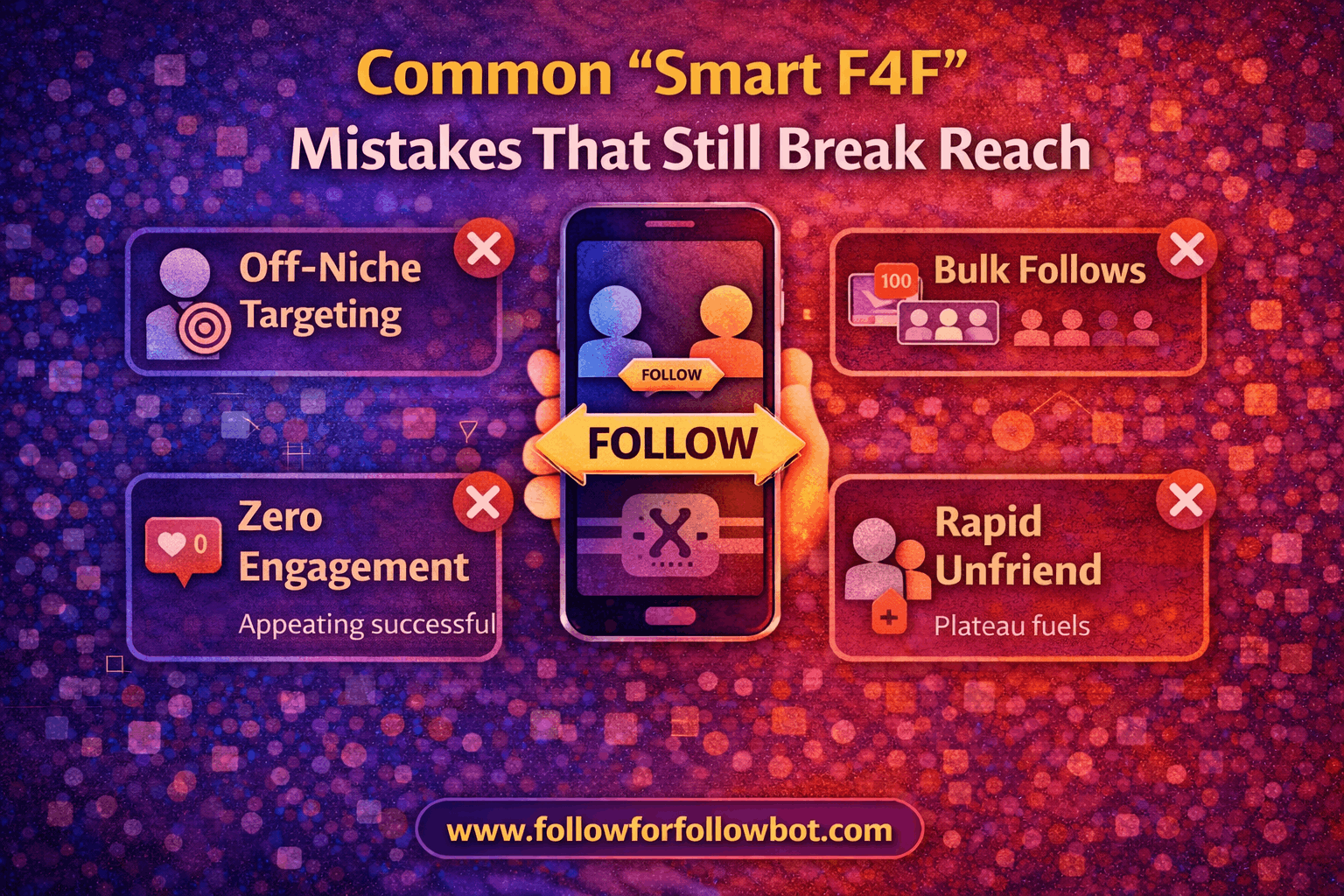
Most creators who attempt “smart” follow for follow believe the issue is execution. They assume that if they are careful enough, selective enough, or subtle enough, the tactic will stop harming reach.
The problem is not how follow for follow is done. It is what the system infers from it.
The most common misconception is confusing reciprocation with interest. A follow-back signals politeness or social obligation, not content relevance. Algorithms do not evaluate intent. They evaluate behavior after the follow. When engagement does not repeat, the connection is classified as low confidence regardless of how carefully it was created.
Noted mistakes that repeatedly undermine reach:
- Following across mixed or loosely related niches
Even small topic mismatches reduce engagement density. The more fragmented the audience, the harder it is for the system to identify who the content is actually for. - Ignoring depth signals like watch time and saves
Likes and follows are surface signals. When deeper signals fail to appear, the system deprioritizes distribution even if follower count grows. - Assuming engagement can be fixed later
Early audience signals shape future testing. Platforms do not reset context easily. Poor early alignment carries forward. - Believing follower count stabilizes reach
Reach is stabilized by repeated interaction, not audience size. Large inactive audiences often reduce, not protect, distribution.
This is why many accounts look healthy at first and then gradually stall. There is no sudden penalty. The system simply becomes less willing to test content because past tests did not confirm interest.
Growth breaks quietly when behavior and relevance diverge.
Why Follow for Follow Stops Being Smart at Scale ?
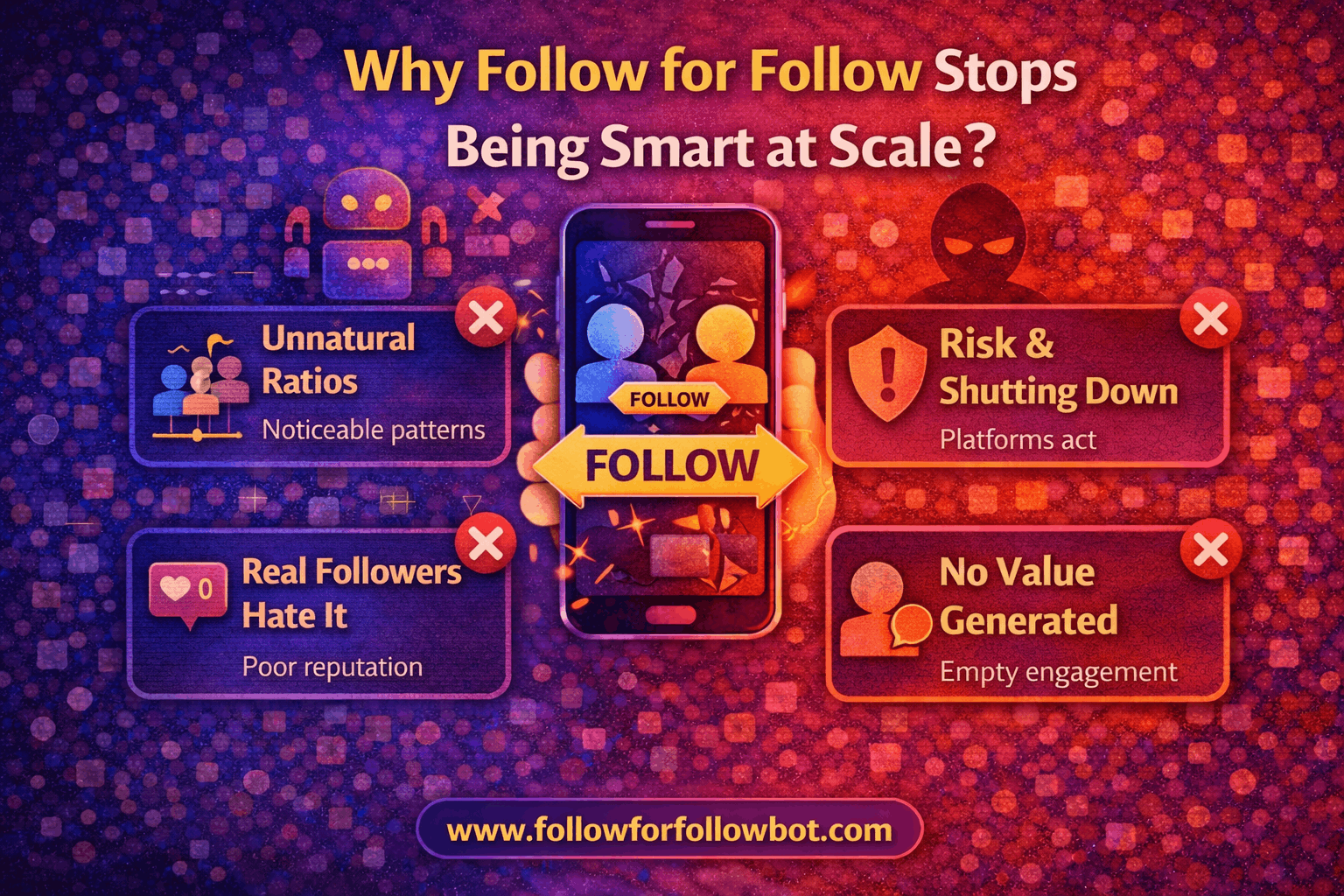
Follow for follow only appears manageable while volume is low. The moment it scales, the underlying weakness becomes unavoidable: audience mismatch.
At scale, your content is no longer tested on people who discovered it through interest. It is tested on people who followed out of obligation. When they scroll past, skip, or fail to return, the platform receives a clear signal that distribution is risky. As a result, reach tightens quietly.
This happens even when follow for follow is done “carefully.” Lower volume, slower pacing, or cleaner execution do not change the outcome. The system does not evaluate how polite the connection was created. It evaluates what happens after content is shown.
Noted dynamics that cause scale failure:
- Testing shifts toward low interest audiences
The larger the mismatched follower base becomes, the more often content is shown to users who are unlikely to engage. - Engagement decay becomes cumulative
Each ignored post reduces confidence, making future tests smaller and more conservative. - Discovery slows before creators notice the cause
Follower count may still rise while reach per post declines, creating confusion instead of clarity. - Recovery becomes harder than initial growth
Once poor audience signals dominate, organic discovery requires significantly more effort to rebuild trust.
This is the pattern unpacked in depth in the Follow for Follow Guide, because it explains why many accounts look like they are growing while becoming harder to distribute at the same time.
There is no version of follow for follow that scales without corrupting signal quality.
What to Do Instead of Scaling Follow for Follow ?
The alternative to follow for follow is not inactivity, and it is not simply posting more content.
What replaces follow for follow is intent based growth. Instead of forcing connections, the goal becomes confirming interest repeatedly.
Noted principles that actually scale:
- Engage where interest already exists
Interaction should happen after content resonance, not before it. - Let follows occur as a byproduct of interaction
When users follow after engaging, the follow itself carries high confidence. - Reinforce behavior that confirms relevance
Replies, saves, repeated views, and return sessions strengthen distribution. - Help the platform identify audience fit faster
Consistent engagement patterns reduce testing friction and expand reach naturally.
This reframes the growth question entirely. Instead of asking, “How many people can I follow today?” the better question becomes, “How do I help the right people engage twice?”
That is how signals compound.
Where Tools Fit (and Where They Don’t)?
Tools do not make follow for follow safe.
Automation does not change the nature of the signal. If the underlying behavior creates audience mismatch, automating it only accelerates the damage. Wrong signals become louder, faster, and harder for the system to ignore. Trust erodes sooner, not later.
This is why so many creators feel like “tools ruined my account” when in reality, the tool simply scaled flawed growth logic.
Where tools do fit is after relevance has already been demonstrated.
Once interest exists, tools can reduce friction in maintaining it: responding consistently, reinforcing interaction, and supporting continuity that humans struggle to sustain manually. At this stage, automation strengthens signals instead of corrupting them.
This is the logic behind MP Suite.
MP Suite is not designed to automate follow-for-follow loops or manufacture numbers. It is built to support intent-aligned growth, reinforcing high-quality engagement after discovery rather than forcing connections before interest exists.
Tools should amplify alignment, not replace judgment.
Final Verdict
There is no smart version of follow for follow at scale.
There are limited contexts where follow-back behavior is natural and harmless. Outside of those, follow for follow is a short-term coping mechanism, not a growth strategy.
If the goal is real reach, stable engagement, and compounding growth, relevance beats reciprocity every time.
For the full breakdown of why follow for follow once worked, why it no longer aligns with platform systems, and what replaced it, start with the Follow for Follow Guide.
And if you want to scale growth without repeating the same mistakes, that is the problem MP Suite was built to solve.