
The question of whether Follow for Follow is still ethical in 2026 comes up frequently as social media platforms tighten rules and users become more aware of artificial growth tactics. Follow for Follow (F4F) is often grouped together with spam, fake followers, or deceptive automation—but that comparison is not always accurate.
In reality, the ethics of Follow for Follow depend less on the tactic itself and more on how it is executed. This article examines what “ethical” means in modern social media growth, how F4F compares to other growth methods, and when Follow for Follow can be considered a legitimate and acceptable strategy in 2026.
What “Ethical” Means in Social Media Growth?
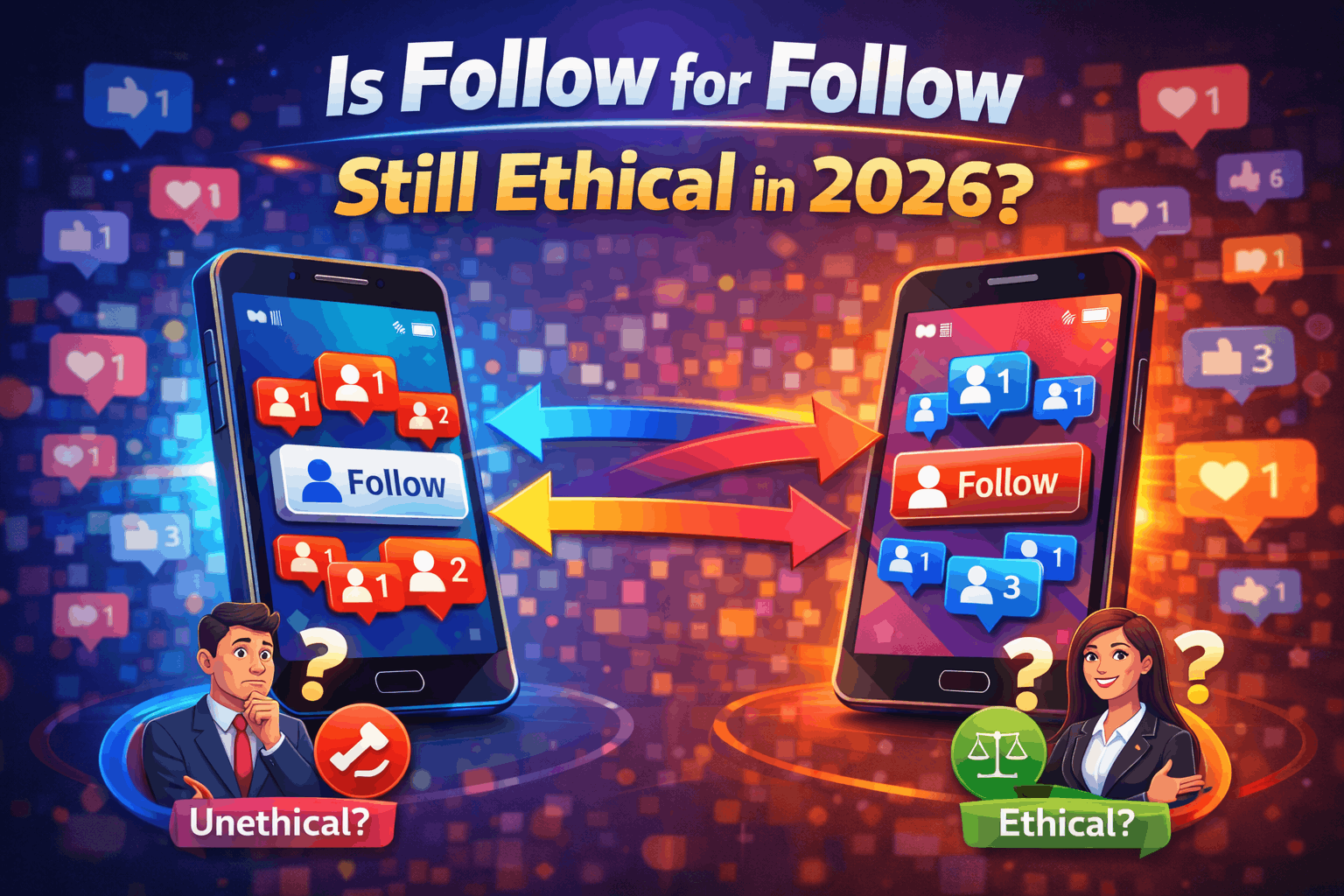
In social media marketing, ethical growth does not mean relying only on organic reach, nor does it require avoiding tools or automation altogether. Ethical growth is defined by how actions affect users and platforms, not by whether those actions are manual or automated.
At a basic level, a growth method is considered ethical when it involves real users, allows voluntary participation, and avoids deception. Users retain control over their actions, platforms are not intentionally abused, and outcomes are not artificially manufactured. Within this framework, posting content, running paid ads, collaborating with creators, and using automation can all be ethical when executed responsibly.
The key factor is transparency of action. Ethical growth does not attempt to misrepresent audience size, fabricate engagement, or create false signals. It operates within the visible mechanics of the platform, where users can choose how to respond and platforms can evaluate behavior naturally.
This distinction matters because many growth techniques that are standard today were once criticized as unnatural or unfair. Scheduled posting, ad targeting, analytics tracking, and automated replies all faced resistance when first introduced. Over time, they became accepted because they aligned with platform rules and improved efficiency without misleading users.
Ethics in social media growth have never been static. They evolve alongside platform design, user expectations, and technological capability. What defines ethical practice in 2026 is not the absence of tools, but the responsible use of them.
Why Follow for Follow Is Often Misunderstood?
Follow for Follow is often misunderstood because it is frequently grouped together with spam-based growth tactics. Many people assume that F4F forces interaction, manipulates users, or artificially inflates follower counts in the same way as fake followers or engagement pods.
In reality, Follow for Follow is a reciprocal action, not a forced one. One account initiates a follow, and the receiving account makes an independent decision about whether to follow back. There is no obligation, no hidden mechanism, and no guarantee of reciprocity. The interaction remains fully visible and reversible at any time.
The ethical confusion arises when the concept of F4F is judged based on its worst executions rather than its core behavior. Random mass-following, irrelevant targeting, and aggressive automation create experiences that feel spam-like, even though the underlying action is still voluntary. These practices distort perception and lead to the assumption that all F4F operates the same way.
When Follow for Follow is applied selectively within a defined niche, it closely mirrors normal social networking behavior. Users discover each other through shared interests, acknowledge visibility through a follow, and decide whether to maintain that connection over time. In this context, F4F is not manipulation—it is structured networking adapted to modern platforms.
F4F vs Fake Followers: A Critical Difference
One of the most important ethical distinctions in social media growth lies in the difference between Follow for Follow and fake followers. Although both aim to increase follower numbers, they operate on entirely different principles.
Fake followers are artificially created accounts or inactive profiles designed to inflate metrics without representing real people. They do not view content, do not interact meaningfully, and do not make independent choices. Their sole purpose is to manufacture the appearance of popularity, which misleads platforms, brands, and audiences evaluating the account.
Follow for Follow, by contrast, involves real users making real decisions. Each follow action is visible, voluntary, and reversible. Even when the motivation is growth rather than genuine content interest, the interaction still occurs between legitimate accounts with agency. There is no fabrication of users and no guaranteed outcome.
This distinction is critical from an ethical perspective. Fake followers replace reality with artificial signals. Follow for Follow works within reality by encouraging reciprocal connection. While the intent may be strategic, the mechanism remains authentic. For this reason, reciprocal interaction between real accounts is far closer to networking than deception.
Is Follow for Follow Against Platform Rules in 2026?
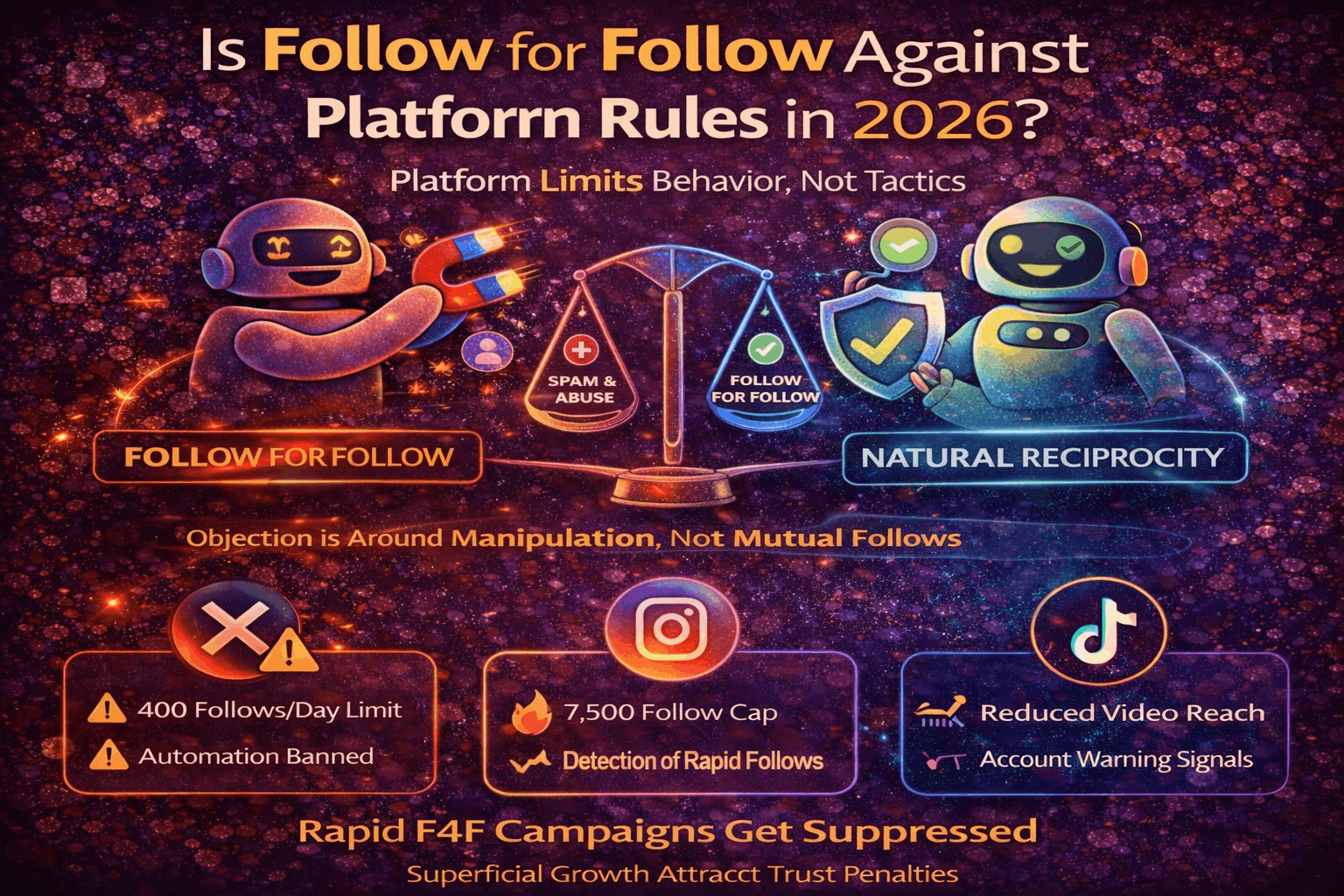
In 2026, major social media platforms enforce rules based on behavioral abuse, not on the presence of specific growth tactics. Platform policies are designed to protect user experience and system integrity, focusing on actions that manipulate engagement, generate spam at scale, or degrade network quality.
Follow for Follow itself is not explicitly prohibited by most platforms. What platforms evaluate is how follows are executed rather than why they occur. Factors such as action speed, repetition, targeting relevance, and overall behavior patterns determine whether activity is considered acceptable or abusive.
Excessive following within short timeframes, aggressive unfollow cycles, or irrelevant mass targeting can trigger limitations regardless of whether those actions are performed manually or through automation. In this sense, misuse of manual methods can be just as problematic as poorly configured tools.
Automation, by itself, is neither unethical nor against platform rules. Modern platforms implicitly tolerate automation when it operates within reasonable limits and reflects normal user behavior. Issues arise when tools are used to bypass safeguards, ignore limits, or generate artificial activity at scale.
In practice, enforcement is outcome-driven. Platforms intervene when behavior appears disruptive or manipulative, not when structured growth actions are executed responsibly.
When Follow for Follow Is Ethical?
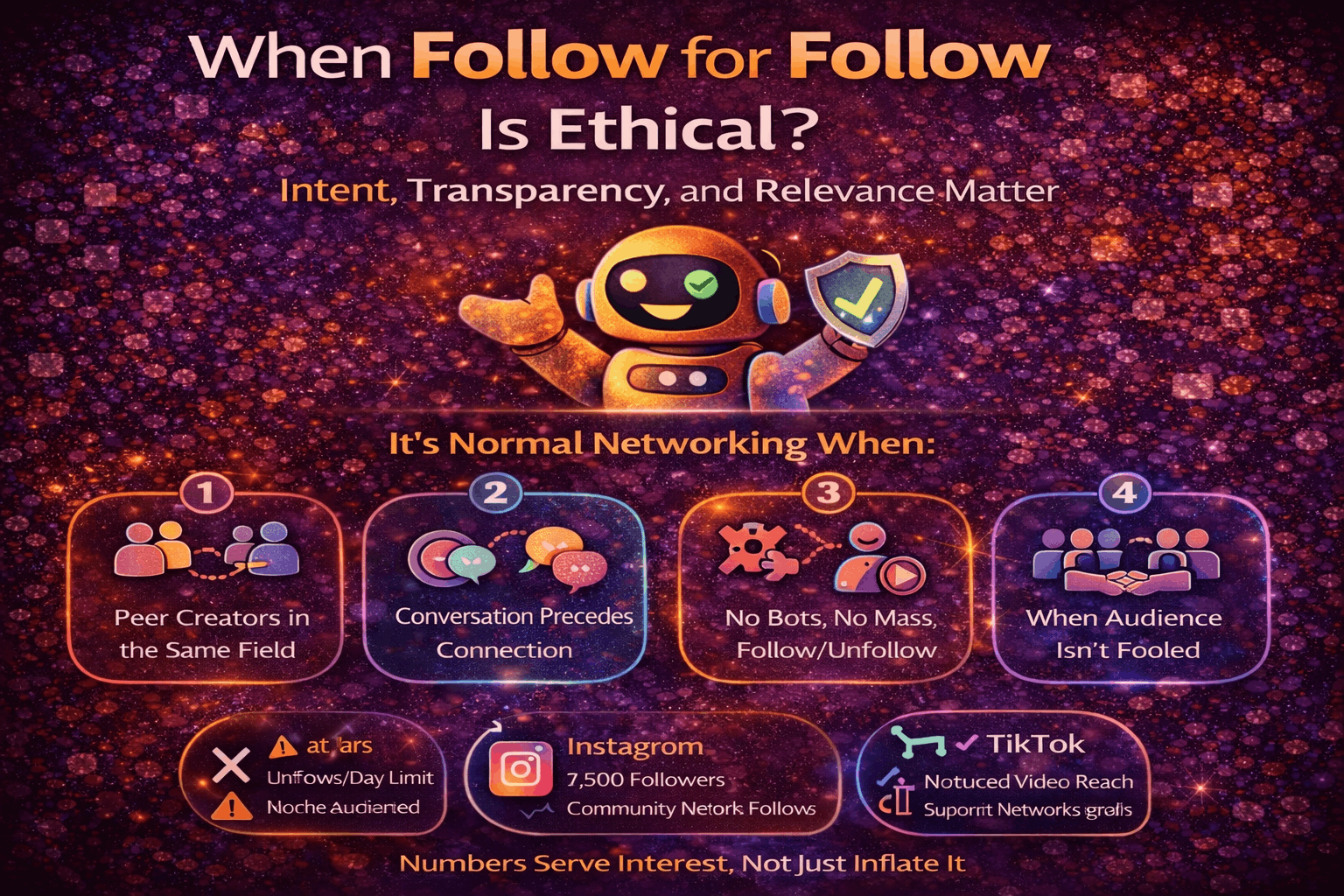
Follow for Follow can be considered ethical when it aligns with how users naturally interact on social platforms and how platforms expect those interactions to occur. Ethics, in this context, are defined by intention, execution, and impact rather than by the presence of tools or automation.
When F4F respects relevance, transparency, and behavioral limits, it functions as a legitimate networking mechanism rather than a manipulative tactic.
Relevance and Targeting
Ethical Follow for Follow begins with relevance. Following users within the same niche, industry, or interest group reflects genuine discovery and networking behavior. Users are more likely to recognize shared context, which makes reciprocal follows more meaningful and sustainable.
Random mass-following unrelated accounts undermines this dynamic. It creates connections without context and increases the likelihood of passive or short-lived follows. Relevance is what separates ethical F4F from spam-like behavior.
When targeting is aligned with shared interests, reciprocal follows are more likely to lead to profile visits, content interaction, and long-term audience retention rather than inflated numbers.
Transparency and Intent
Ethical F4F does not disguise its purpose. The follow action is visible, simple, and easy to reverse. Users retain full control over whether they follow back, stay connected, or disengage later.
There is no impersonation, no misleading representation of intent, and no attempt to force engagement. The interaction is based on choice rather than pressure, which keeps the exchange within acceptable ethical boundaries.
Transparency ensures that growth occurs through open interaction rather than hidden manipulation.
Controlled Automation
In 2026, meaningful scale requires systems. Controlled automation supports ethical execution by applying consistent pacing, respecting platform limits, and enforcing relevance rules that are difficult to maintain manually at scale.
Well-designed automation reduces erratic behavior and prevents excessive actions that trigger platform restrictions. By standardizing execution, it often results in cleaner, more compliant activity than unstructured manual efforts.
The ethical concern is not automation itself, but automation without constraints. When automation operates within defined boundaries, it supports responsible growth rather than undermining it.
When Follow for Follow Crosses the Line ?
Follow for Follow crosses ethical boundaries when it shifts from reciprocal networking to deceptive manipulation. The problem is not the exchange itself, but the intent and execution behind it.
This typically occurs when accounts rely on irrelevant mass targeting with no contextual connection, creating interactions that feel intrusive rather than purposeful. It also happens when F4F is used to create misleading expectations—such as inflating numbers to imply influence or authority that does not actually exist.
Automation becomes unethical when it ignores platform limits, operates at unnatural speeds, or prioritizes volume over relevance. These practices generate artificial signals, degrade user experience, and increase the likelihood of platform enforcement.
Importantly, these scenarios represent misuse, not the core concept of Follow for Follow. Ethical failures occur at the implementation level, not at the strategic level.
Why Ethical Automation Is the New Standard?
As social media platforms scale and competition intensifies, manual interaction alone has become impractical for sustained growth. Ethical automation has emerged as the standard approach because it enables consistency, moderation, and relevance at scale.
Well-designed tools allow marketers to define clear rules: who to target, how often to act, and when to stop. This structured execution reduces impulsive behavior, excessive actions, and human error—factors that often cause problems in manual growth.
Manual growth is not inherently more ethical than automated growth. In many cases, automation is safer because it enforces limits that individuals might ignore under pressure to grow quickly.
Modern growth strategies treat automation as infrastructure. It is not a shortcut or a trick, but a system for executing proven behaviors responsibly, efficiently, and in alignment with platform expectations.
Follow for Follow with MP Suite: Relevance Over Volume
As Follow for Follow matured, the focus shifted from volume to selectivity. Modern F4F is no longer about following as many accounts as possible, but about following the right ones. This is where MP Suite fits naturally into the evolution of ethical Follow for Follow.
MP Suite applies Follow for Follow with clear targeting logic. Instead of random mass-following, actions are directed toward users within the same niche, interest group, or behavioral context. This keeps the exchange relevant and preserves the networking nature of F4F rather than turning it into noise.
By operating within defined limits and consistent pacing, MP Suite reflects how platforms expect real users to behave. Follow actions are spaced, filtered, and adjusted based on context, reducing spam-like patterns and maintaining account stability.
In practice, this approach aligns Follow for Follow with the ethical conditions discussed earlier. Users retain choice, interactions remain transparent, and growth is supported by relevance rather than brute force. MP Suite does not change the principle of Follow for Follow—it simply executes it in a way that fits modern platforms and user expectations.
Final Answer: Is Follow for Follow Ethical in 2026?
Yes—Follow for Follow is still ethical in 2026 when it is executed correctly.
Ethics in social media growth are defined by transparency, relevance, and respect for user choice. Follow for Follow meets those standards when it involves real users, voluntary interaction, and controlled execution.
The question is no longer whether F4F is ethical, but whether it is applied intelligently. In modern social media marketing, responsible systems matter more than outdated judgments about tactics.