
If you’ve spent any time on Instagram, TikTok, or X (formerly Twitter), chances are you’ve seen the term F4F in someone’s bio, comments, or hashtags. At first glance, it looks like just another piece of internet slang. In reality, F4F represents one of the oldest and most controversial growth tactics in social media history.
In this guide, we’ll break down exactly what F4F means, how it’s used across different platforms, why people still rely on it today, and whether it actually helps—or hurts—your social media growth in the long run.
What Does F4F Mean on Social Media?
F4F stands for “Follow for Follow.” The concept is simple: you follow someone, and in return, they follow you back.
The abbreviation exists because social media culture favors speed and brevity. Typing “F4F” in a comment or bio is faster and more recognizable than writing out “follow me and I’ll follow you back.” Over time, it evolved into a widely understood signal among users looking to grow their follower count quickly.
At its core, F4F is not about content quality or genuine interest. It’s a mutual exchange designed to inflate follower numbers, often regardless of relevance or engagement.
Where Is F4F Commonly Used?
While the concept of Follow for Follow is universal, the way it appears—and how effective it is—varies significantly from one platform to another. Each social network has its own culture, algorithmic priorities, and user behavior patterns, which directly influence how F4F is practiced and perceived.
Understanding these differences is crucial if you want to use F4F intentionally rather than blindly copying what others do.
F4F on Instagram
Instagram is the platform where F4F truly went mainstream. From the early days of influencer marketing, users have relied on mutual follows to break through the initial growth barrier. It’s common to see F4F signals in bios, captions, comments, and hashtags such as #f4f or #followforfollow.
For new accounts, Instagram can feel unforgiving. Without followers, posts receive little engagement, and without engagement, content struggles to reach new users. F4F offers a shortcut out of this loop by helping profiles gain early social proof. A higher follower count can make an account appear more established, even if the engagement behind it is minimal.
However, Instagram’s algorithm has evolved. Today, it evaluates not only follower numbers but also interaction quality, consistency, and behavioral patterns. Aggressive or poorly targeted F4F activity can be interpreted as spam, leading to reduced reach or account restrictions. As a result, F4F on Instagram has shifted from a mass tactic to something that requires careful moderation and relevance.
F4F on TikTok
On TikTok, F4F exists, but it plays a much smaller role in growth. Instead of bios or hashtags, F4F interactions usually happen in comment sections. Creators might reply with “F4F” or pin a comment offering mutual follows to encourage quick exchanges.
The reason F4F is less powerful on TikTok comes down to the algorithm. TikTok prioritizes content performance, not follower count. Videos are pushed to the For You page based on watch time, completion rate, and interaction—often regardless of how many followers the creator has.
As a result, F4F may increase follower numbers, but those followers rarely contribute to views, retention, or engagement. In many cases, they never see the creator’s content again. For TikTok, F4F is more cosmetic than functional, offering minimal impact on actual growth.
F4F on Twitter (X)
On X, F4F tends to be more community-driven. Instead of random exchanges, it often appears in engagement threads or niche-based discussions. Users may offer F4F within specific industries such as crypto, marketing, tech, or startups, where mutual visibility is part of the culture.
Unlike Instagram, relationships on X are more conversational. Following someone often leads to replies, reposts, or ongoing interaction. Because of this, pure F4F—without engagement—has limited value. A follow alone doesn’t guarantee visibility unless it’s reinforced through replies and participation in discussions.
When combined with active engagement, F4F on X can help users integrate into communities faster. When used passively, it becomes just another number with little influence on reach or authority.
How Does Follow for Follow Actually Work?
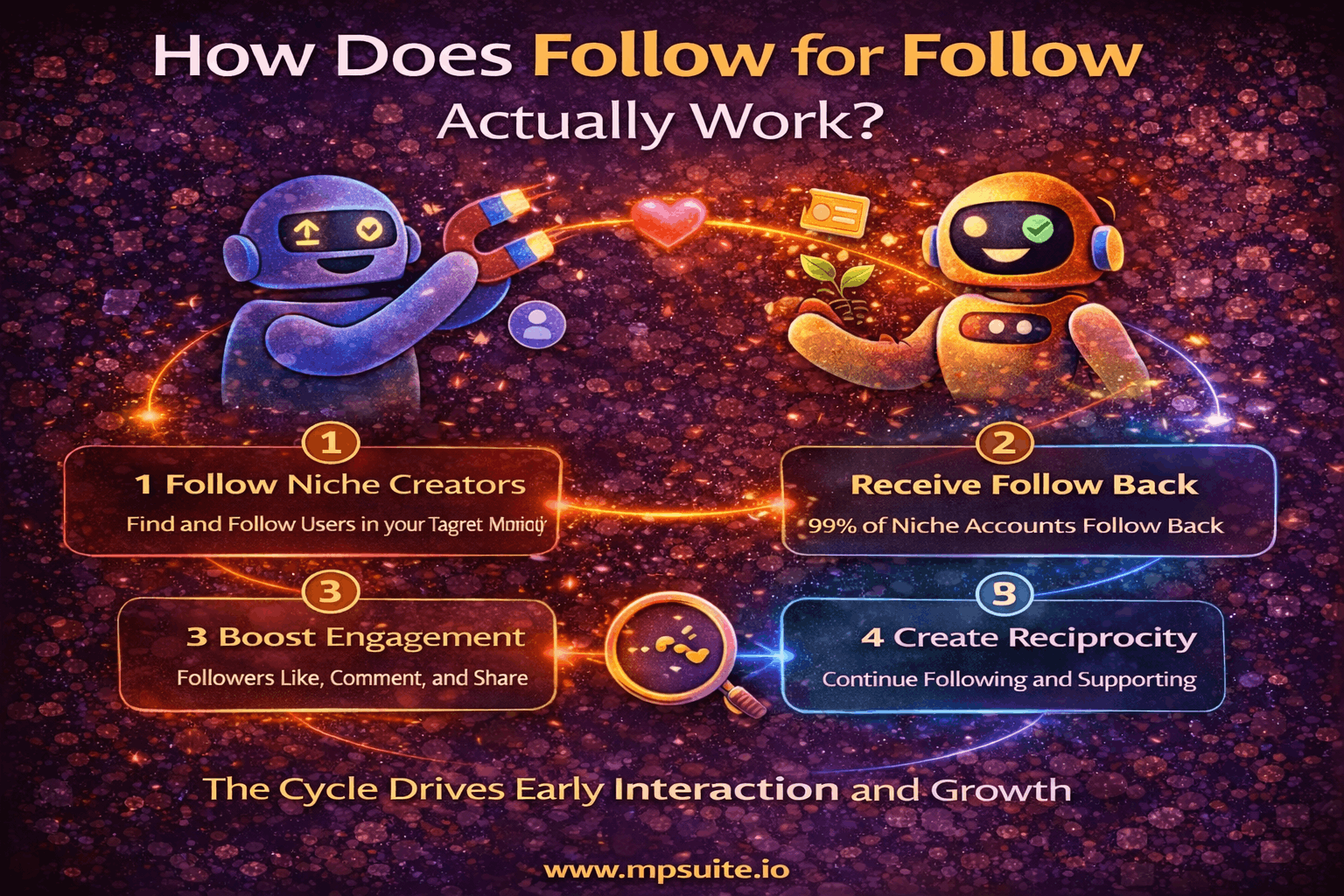
At a surface level, Follow for Follow looks simple: one follow is exchanged for another. But underneath that simplicity is a combination of human psychology, platform mechanics, and algorithmic signals that explain why F4F works at all—and why it often stops working over time.
In practice, F4F operates through two main approaches: manual interaction and automation. While the execution differs, both rely on the same fundamental principle of social reciprocity.
Manual Follow for Follow
Manual F4F is the most basic form of the strategy. Users actively search for posts, hashtags, or accounts within their niche and follow them individually, expecting a follow back in return. This approach mimics natural behavior, which is why it initially feels safer and more “authentic.”
However, manual F4F is highly inconsistent. Some users reciprocate immediately, others ignore the follow, and many will unfollow days or weeks later once the exchange has served its purpose. The process also demands significant time and attention, making it difficult to scale without sacrificing consistency or quality.
From an algorithmic perspective, manual F4F can still raise red flags if patterns become repetitive. Rapid follow bursts, irrelevant targeting, or high unfollow rates can signal artificial behavior, even when no automation is involved.
Automated Follow for Follow
Automated F4F relies on tools or bots to execute follows at scale based on predefined criteria such as hashtags, locations, or account types. Instead of manually interacting with dozens of profiles, automation allows users to reach hundreds in the same amount of time.
The advantage is speed and efficiency. Automation removes human limitations and creates steady, predictable growth. The downside is risk. Platforms are designed to detect abnormal behavior patterns, and aggressive automation—especially when poorly configured—can trigger restrictions, shadowbans, or account penalties.
Well-managed automation focuses on moderation and relevance. Poorly managed automation prioritizes volume. The difference between the two often determines whether F4F becomes a growth lever or a liability.
The Psychology Behind F4F
Regardless of whether it’s manual or automated, F4F works because of social reciprocity. When someone follows you, there is a subtle psychological pressure to return the gesture. On social platforms, a follow is a low-effort action, making reciprocity even more likely.
There is also an element of perceived fairness. Users feel that returning a follow maintains balance and avoids appearing dismissive. This dynamic explains why F4F can generate results even when there is no genuine interest in the content itself.
Why F4F Often Loses Effectiveness Over Time
The same mechanism that makes F4F effective in the short term also limits it in the long term. As follower lists fill with users who have no real interest, engagement rates decline. Algorithms notice this mismatch between follower count and interaction, reducing organic reach.
What starts as momentum can slowly turn into friction. Without content quality and audience relevance to support it, F4F becomes unsustainable.
Despite years of criticism, F4F remains popular for a reason.
For beginners, the biggest challenge on social media is visibility. A profile with five followers feels invisible, while one with five hundred looks established. F4F offers a fast way to cross that psychological barrier.
Others use F4F as a kickstart strategy. They don’t expect it to drive long-term success, but they see it as a temporary boost that makes future organic growth easier.
There’s also the perception of authority. Brands, influencers, and even casual users know that people often judge credibility by follower count, even subconsciously. F4F feeds directly into that bias.
Is F4F Good or Bad for Your Account?
The truth is that F4F is neither inherently good nor inherently bad. Its impact depends entirely on how and why you use it.
On the positive side, F4F can help new accounts escape obscurity. It’s low-cost, easy to understand, and can generate momentum quickly. For testing ideas or warming up a brand-new profile, it can serve a practical purpose.
On the negative side, F4F almost always results in low-quality followers. These users didn’t follow you because they care about your content. As a result, engagement rates often drop, which can send negative signals to platform algorithms. In extreme cases, aggressive F4F behavior can trigger spam detection or account restrictions.
In short, F4F solves a surface-level problem (follower count) while potentially creating deeper ones (engagement quality and trust).
F4F vs Organic Growth: The Real Difference
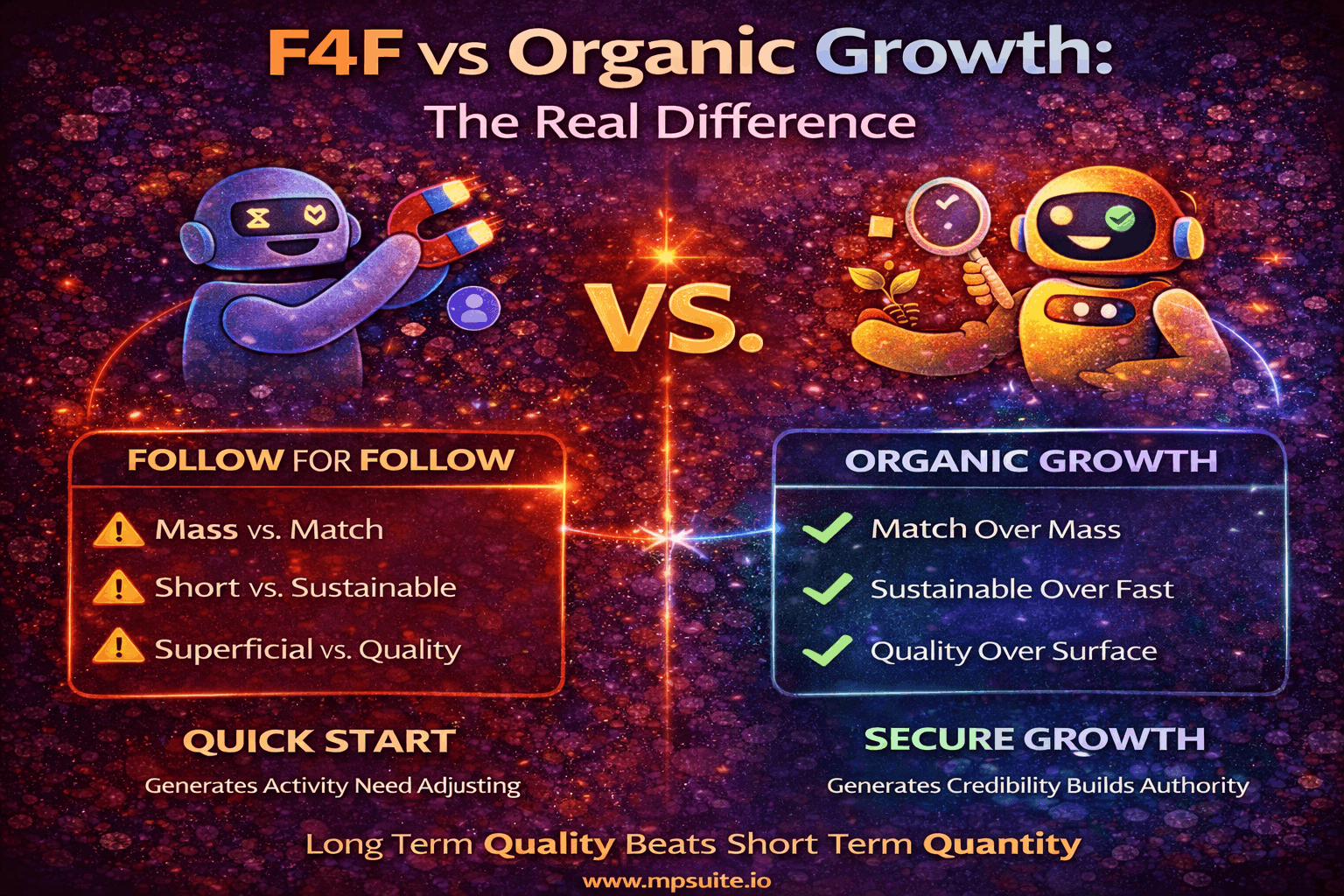
Follow for Follow and organic growth are often positioned as opposites, but in practice, they solve different problems at different stages of social media growth.
Organic growth is built on content value, relevance, and long-term audience alignment. It compounds over time, but it also takes time to gain traction—especially for new or low-visibility accounts.
F4F, on the other hand, is built on momentum. It helps accounts gain early visibility, social proof, and presence in competitive environments where content alone may struggle to get noticed. For new brands, creators, and marketers, this initial boost is often what allows organic strategies to start working at all.
The key distinction is not quality versus shortcuts, but sequence. F4F accelerates early-stage growth, while organic content sustains it. When combined correctly, F4F does not replace organic growth—it unlocks it.
Algorithms respond to signals. When F4F is executed with relevance and pacing, it contributes to those signals rather than damaging them. The issue is not F4F itself, but how it is applied.
Is Using F4F Bots Safe?
Automation is not a shortcut – it’s a multiplier.
F4F bots exist because manual follow-for-follow is inefficient, inconsistent, and impossible to scale. Automation allows marketers to apply the same actions with better control, precision, and timing.
Modern F4F automation tools are designed to operate within platform boundaries. They follow users gradually, unfollow non-responders intelligently, and target audiences based on niche relevance rather than randomness. When used properly, automation reduces human error and creates more predictable outcomes than manual actions.
Risk does not come from automation—it comes from misuse. Excessive volume, poor targeting, and outdated tools are what cause problems. Responsible automation, especially when managed through a unified system, is both practical and sustainable.
From a platform perspective, automation aligned with normal user behavior is far less problematic than chaotic, manual activity done at scale.
Why Marketers Use MP Suite–Based Automation?
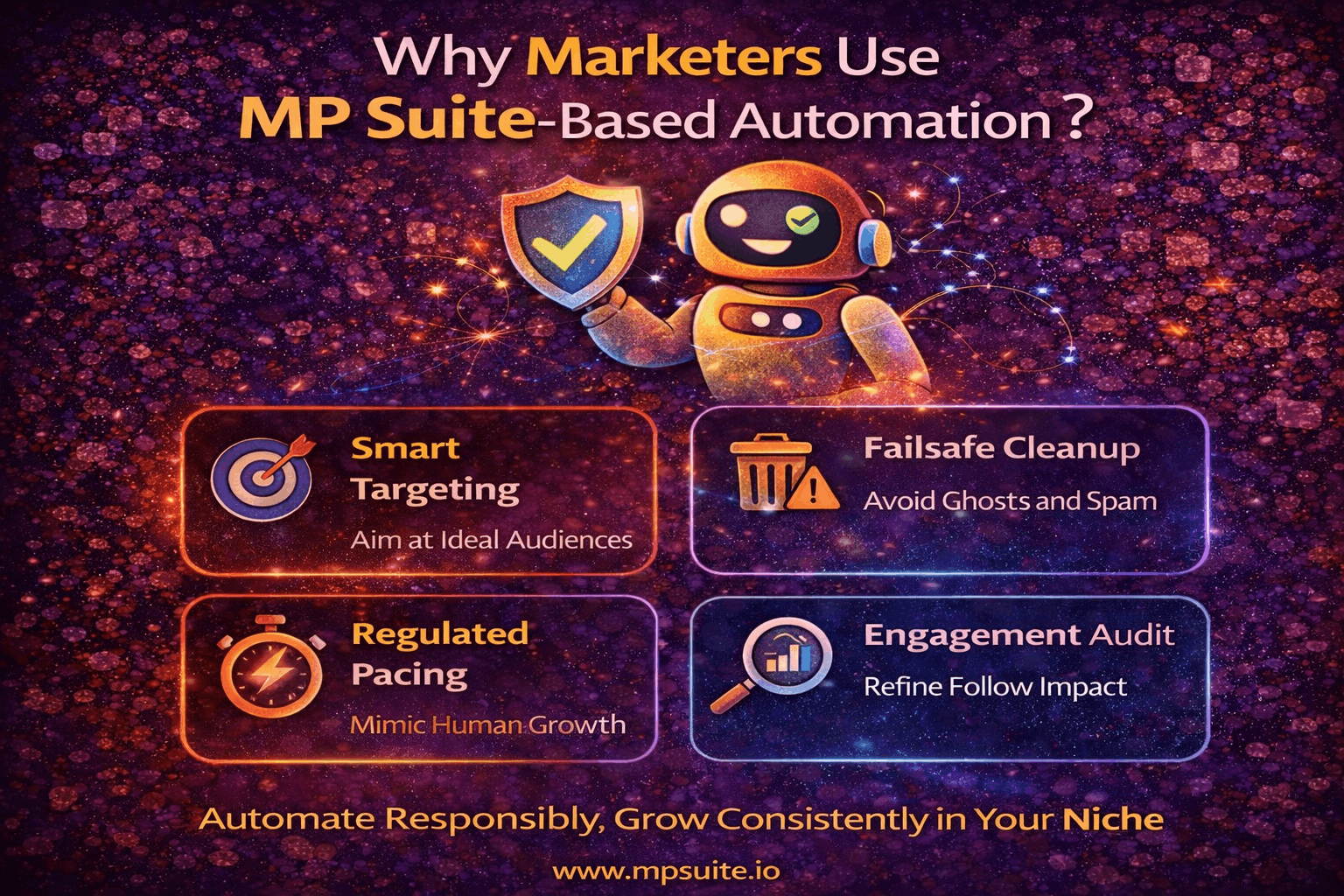
As social media marketing becomes more complex, marketers are moving away from single-function bots toward MP (multi-platform) automation suites.
An MP Suite allows F4F activity to be coordinated across platforms, accounts, and campaigns while maintaining consistent pacing and targeting. This reduces risk, increases efficiency, and ensures that F4F supports broader growth objectives rather than operating in isolation.
Instead of asking whether F4F should be used, advanced marketers focus on how it’s integrated. When follow-for-follow actions are combined with content publishing, engagement tracking, and unfollow logic, automation becomes part of a controlled growth system.
This is why MP Suite–based automation is increasingly seen not as a growth hack, but as infrastructure.
Should You Use F4F in 2026?
In 2026, social media growth is no longer about choosing between organic strategies and automation. The most effective accounts use both.
F4F remains a valuable tool for launching new accounts, validating niches, and creating early credibility. When applied strategically, it reduces the time and uncertainty involved in early growth phases and allows creators to focus on content and engagement.
The difference between outdated F4F tactics and modern F4F strategies lies in execution. Smart automation, relevance-based targeting, and controlled pacing make F4F more sustainable today than it has ever been.
Used correctly, F4F is not something to avoid—it is something to optimize.
Final Thoughts on F4F Meaning
F4F, or Follow for Follow, is more than just slang. It’s a reflection of how people navigate visibility, competition, and psychology on social media.
Used carelessly, it can damage engagement and trust. Used intelligently, it can serve as a stepping stone toward sustainable growth.
Understanding what F4F really means—and how it works beneath the surface—allows you to decide whether it fits your goals, rather than blindly copying what everyone else is doing.
If your aim is long-term influence, remember this: follower numbers open doors, but real engagement keeps them open.