
Follow for follow usually doesn’t fail because creators do it “wrong.” It fails because they misunderstand what it actually does to growth systems.
Most people who use follow for follow believe the problem lies in execution: too fast, too aggressive, wrong tool, wrong timing. So they tweak volume, switch tools, slow things down, or promise themselves they’ll clean it up later.
What they rarely question is the logic itself.
This article breaks down the most common follow for follow mistakes that quietly damage reach and engagement even when the tactic appears to be working. Not the obvious spammy ones, but the subtle errors that teach platforms the wrong lesson about your audience.
Mistake 1: Confusing Follow-Backs With Real Interest
The most fundamental mistake is assuming a follow-back equals relevance.
It doesn’t.
A follow-back is a social response, not an interest signal. People follow back because it feels polite, because they don’t want to appear rude, or because they expect reciprocity. None of those motivations guarantee they care about your content.
Platforms treat follows as hypotheses, not confirmations. The confirmation comes from behavior afterward: watching, saving, replying, returning. When those behaviors don’t happen, the system learns that the connection is weak regardless of how the follow occurred.
This is why accounts can grow in followers while shrinking in reach. The algorithm isn’t confused. It’s responding accurately to what it observes.
Mistake 2: Following Across Mixed or Unrelated Niches
Another common error is prioritizing volume over relevance.
Creators often follow anyone who looks active or might follow back, even when there is no meaningful overlap in content, audience, or intent. On the surface, this feels harmless. After all, a follow is just a follow.
Algorithmically, it isn’t.
When your content is shown to a fragmented audience that shares no common interest, engagement becomes inconsistent. Some posts resonate with a small subset, most get ignored. Over time, the platform struggles to identify who your content is actually for.
This loss of audience clarity is one of the fastest ways to weaken organic discovery. Growth slows not because content quality dropped, but because relevance signals became noisy.
Mistake 3: Ignoring What Happens After the Follow
Many creators stop measuring the moment the follow happens.
They track follow-back rates, follower growth, and maybe short-term likes. What they don’t track is what happens in the days and weeks after: do those new followers ever engage again, do they watch full posts, do they interact more than once.
From the platform’s perspective, this post-follow window is where meaning is created.
When engagement collapses immediately after the follow, it teaches the system that the connection was superficial. Multiply that pattern across dozens or hundreds of followers and distribution becomes more conservative, not as a punishment, but as a risk adjustment.
Creators often don’t notice this until reach per post starts slipping.
Mistake 4: Believing Engagement Can Be Fixed Later
One of the most damaging beliefs around follow for follow is the idea that you can clean it up later.
The logic sounds reasonable: build followers now, improve engagement later, remove inactive users if needed. Unfortunately, platforms don’t work like editable spreadsheets.
Early signals shape future distribution. When a system learns that your followers consistently ignore content, that context sticks. Removing followers later doesn’t erase the behavioral history that informed earlier decisions.
This misconception is explained in depth in the Follow for Follow Guide, because it is one of the main reasons creators feel stuck even after changing strategies.
Growth systems remember patterns longer than creators expect.
Mistake 5: Using Automation to Scale a Weak Strategy
Automation doesn’t create the problem. It amplifies it.
When follow for follow already produces low-confidence connections, automation simply produces more of them, faster. Slower automation doesn’t fix the issue. Cleaner automation doesn’t either.
The system doesn’t evaluate how polite or careful the behavior looks. It evaluates outcomes.
This is why many creators bounce between tools instead of rethinking strategy. They assume the wrong tool caused the damage, when in reality the tool just accelerated flawed logic.
Mistake 6: Measuring the Wrong Metrics
Follower count is easy to see. Engagement quality is not.
Creators often judge success by visible growth while ignoring engagement density, repeat interactions, saves, replies, and return behavior. These quieter metrics are what platforms actually use to decide whether content deserves wider testing.
When follower count increases but these signals weaken, the account looks healthy to the creator and risky to the algorithm.
This mismatch in measurement leads to delayed reactions and harder recoveries.
Why These Mistakes Compound Over Time?
Follow for follow almost never collapses all at once. It erodes performance quietly.
Each low interest follow slightly weakens the platform’s confidence in your audience alignment. Each post that gets shown and ignored teaches the system that distribution carries risk. None of these signals are strong enough to trigger alarms on their own. That is why creators rarely notice the damage while it is happening.
Over time, however, these small signals stack. The algorithm becomes more conservative about testing new audiences. Reach contracts. Engagement density thins out. Growth slows even though effort increases.
By the time creators recognize the pattern, they often face a confusing reality: a larger follower count paired with weaker visibility than before. From the platform’s perspective, nothing is wrong. The system is behaving rationally based on the behavior it has observed and remembered.
This is why follow for follow feels like it stopped working rather than clearly failed. It did not break. It taught the system the wrong lesson, gradually and consistently.
What to Do Instead of Repeating These Mistakes ?
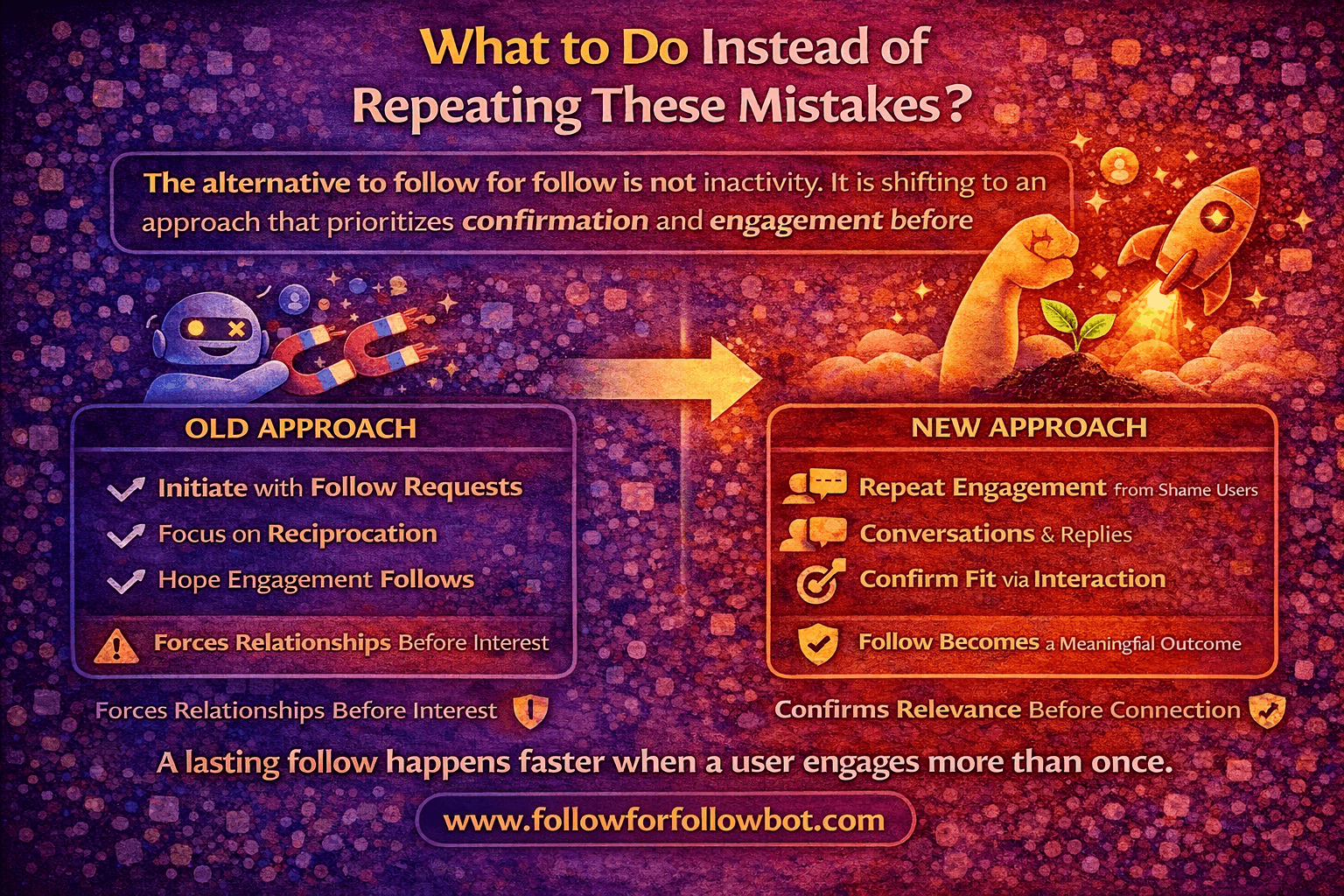
The alternative to follow for follow is not inactivity. It is a shift in how growth is approached.
Many creators believe the only options are either aggressive networking tactics or slow organic waiting. In reality, the difference is not about doing more or less work. It is about where effort is applied in the growth process.
Follow for follow systems attempt to create relationships before any real interest exists. They assume that connection will eventually lead to engagement. Modern platforms operate in the opposite direction. Engagement is expected to appear first, and the follow becomes a natural outcome of repeated interest.
This means the order of actions matters.
Instead of initiating growth with a follow request, sustainable strategies begin with visibility and interaction. When a user discovers content, interacts with it, and later returns to engage again, platforms recognize that pattern as relevance. That pattern carries far more weight than a simple follow action.
This creates a completely different growth structure.
Rather than chasing reciprocal actions, the focus shifts toward behavior confirmation. Users who interact more than once signal that the content aligns with their interests. When that signal appears, a follow becomes meaningful because it reflects genuine audience fit.
A healthy growth system therefore prioritizes signals like:
• Repeat engagement from the same users
• Conversations through comments or replies
• Profile visits that happen after content interaction
• Followers who continue interacting after connecting
These signals tell the platform that the relationship is real, not mechanical.
Once that relationship pattern begins forming, distribution tends to expand more naturally. Platforms prefer promoting content that demonstrates authentic audience response. When users consistently interact with posts before following, the algorithm receives clear evidence that the content deserves wider exposure.
This is why growth built on engagement often compounds over time.
At the beginning, the process may appear slower. Follower numbers might increase gradually rather than spiking quickly. However, the audience being built is structurally stronger. These followers are more likely to interact with future posts, share content, and return repeatedly.
Over time, this stability becomes a major advantage.
Accounts built through follow for follow often experience an early surge followed by stagnation. Engagement drops because the audience was never aligned with the content. Platforms detect the mismatch and reduce distribution accordingly.
Accounts built through relevance signals follow the opposite trajectory. Early growth is moderate, but engagement remains stable. Because the platform continues to detect positive signals, reach expands rather than contracts.
This is the core mental shift creators must make.
Growth is not about asking how many people can be followed today.
It is about asking how many of the right people interact more than once.
When the same users repeatedly respond to content, the algorithm receives confirmation that the audience and message are aligned. That alignment is what transforms temporary visibility into long term distribution.
The difference between these two approaches is subtle but powerful. One focuses on manufacturing motion. The other focuses on building signals that platforms trust.
Sustainable growth always comes from the second path.
Where Tools Fit Without Repeating These Errors?
Tools are often blamed for damaging accounts, but the reality is simpler. Tools do not create strategy. They only execute it.
Automation amplifies whatever logic it is given.
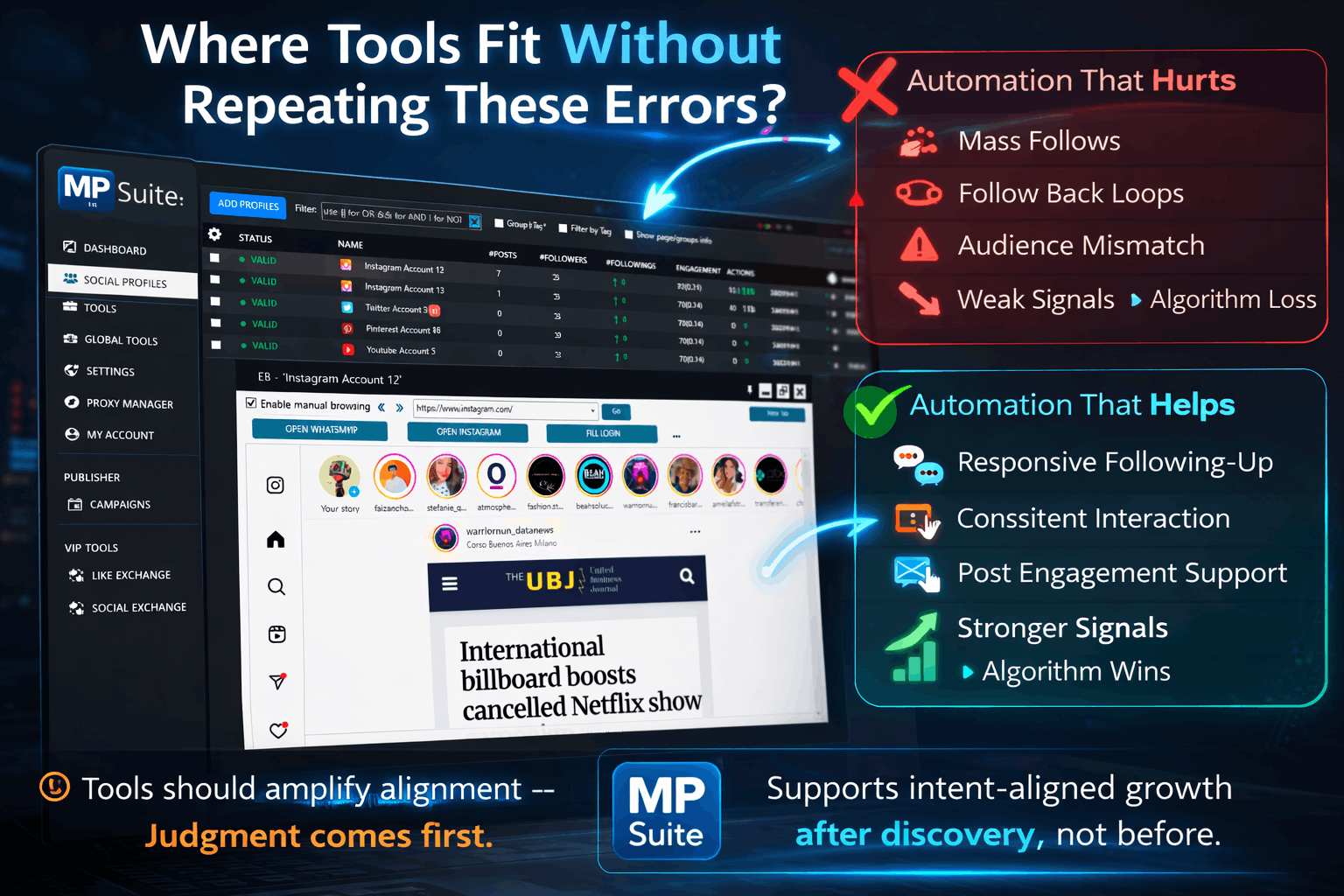
When automation is used to accelerate follow for follow tactics, the results simply appear faster. Accounts accumulate large numbers of connections, but engagement remains weak. Platforms interpret this mismatch as low relevance and gradually limit distribution.
In this situation, automation is not the root problem. The underlying growth logic is.
Scaling audience mismatch only produces a larger version of the same issue. More followers appear on the surface, but fewer of them actually interact with content. As this pattern continues, algorithmic confidence declines and organic reach becomes increasingly restricted.
This is why many creators feel that automation eventually stops working. In reality, the automation worked exactly as designed. It scaled behavior that platforms already considered low quality.
Where tools actually provide value is in a completely different stage of the growth process.
Instead of creating connections before interest exists, effective tools support activity after relevance has already appeared.
Once users begin interacting with content, maintaining consistent engagement becomes the priority. Responding to comments, continuing conversations, and staying active around existing interest helps reinforce signals the platform already trusts.
Tools can assist by reducing friction around these actions.
For example, automation can help creators remain responsive when engagement spikes. It can support consistent interaction across multiple posts and ensure that meaningful conversations are not missed. Rather than fabricating attention, the tool helps sustain momentum where attention already exists.
This is the environment where automation strengthens growth rather than weakening it.
Instead of creating artificial signals, tools reinforce signals that platforms are already rewarding. When engagement continues over time, algorithms interpret the pattern as sustained relevance. Distribution expands because the system observes consistent audience response.
This is the philosophy behind MP Suite.
MP Suite was not designed to automate follow for follow loops or inflate superficial metrics. Its role is to support the behaviors that strengthen platform trust after discovery occurs.
Rather than manufacturing connections before interest exists, the software focuses on reducing friction around authentic engagement. That includes helping creators stay active where conversations are happening, maintaining continuity with interested users, and reinforcing signals that demonstrate audience alignment.
In this context, automation becomes an amplifier of quality rather than quantity.
Tools should never replace judgment. Strategy must always come first.
But when tools are used to support relevance based growth instead of forcing artificial connections, they can significantly improve consistency. And consistency is one of the strongest signals platforms look for when deciding which content deserves broader distribution.
The rule is simple.
Tools should amplify alignment.
Human judgment should decide what gets amplified.
Final Takeaway
Most follow for follow failures are not caused by speed, volume, or the wrong platform. They are caused by confusing movement with progress.
Follower numbers can increase while growth systems quietly lose confidence. Once that happens, recovery is harder than starting correctly.
If you want a deeper breakdown of why follow for follow behaves this way and what replaces it structurally, start with the Follow for Follow Guide.
If you want to scale growth without repeating these mistakes, MP Suite exists to support that shift, not shortcut it.