
Follow for follow has a reputation problem and for good reason.
Search almost any platform or Reddit thread for “follow for follow messed up engagement” and you’ll see the same story repeated: follower count went up, reach went down, engagement never recovered.
But the full picture is more nuanced.
Follow for follow doesn’t always hurt engagement immediately. In rare cases, it can even create a short-term boost. The problem is what happens next—and why most creators misunderstand the difference.
To understand that distinction, you need to separate short-term activity spikes from long-term engagement health, which we explain at a foundational level in the complete follow for follow pillar guide.
When Follow for Follow Appears to Boost Engagement ?
In the short term, follow for follow can create what looks like a genuine engagement lift—especially on small or newly created accounts.
Right after a reciprocal follow, some users will like a recent post, skim a caption, or leave a quick comment. This behavior is not random. It’s a social reflex. When someone follows you back, there is an unspoken expectation to “do something” in return. A like, an emoji, or a generic comment satisfies that obligation.
On accounts with limited baseline activity, this feels significant. A post that normally gets two likes suddenly gets ten. Notifications increase. Engagement rate appears to improve. From the creator’s perspective, this looks like momentum.
The illusion is strongest in the first few days.
What’s actually happening is not increased interest, but front-loaded reciprocity. Engagement is being pulled forward in time, not created. Users engage once to close the social loop, then disengage entirely.
This is why the boost rarely survives past the initial window.
When the next post appears, there is no obligation left to fulfill. The same users who liked or commented before scroll past without slowing down. Watch time drops. Interaction disappears. The algorithm compares the first interaction with the second—and learns that the relationship is unstable.
Modern systems are designed to detect repeat behavior, not one-off reactions. A single like has almost no weight by itself. What matters is whether the same user consistently watches, interacts, and returns over time.
Follow-for-follow engagement fails this test.
Because the engagement is obligation-driven rather than interest-driven, it does not repeat. And engagement that does not repeat does not compound.
This is where the apparent boost becomes a liability.
Algorithms interpret inconsistency as uncertainty. If a group of users interacts once and then disengages, the system reduces confidence in future distribution. Instead of expanding reach, it narrows testing. Instead of rewarding the spike, it discounts it.
Creators often misread this phase as “proof” that follow for follow works—because they are looking at immediate signals. The platform is looking at longitudinal patterns.
Short spikes impress humans.
Consistency trains algorithms.
This is why follow for follow can appear to boost engagement early, while quietly undermining it over time.
Why Follow for Follow Hurts Engagement Long-Term ?
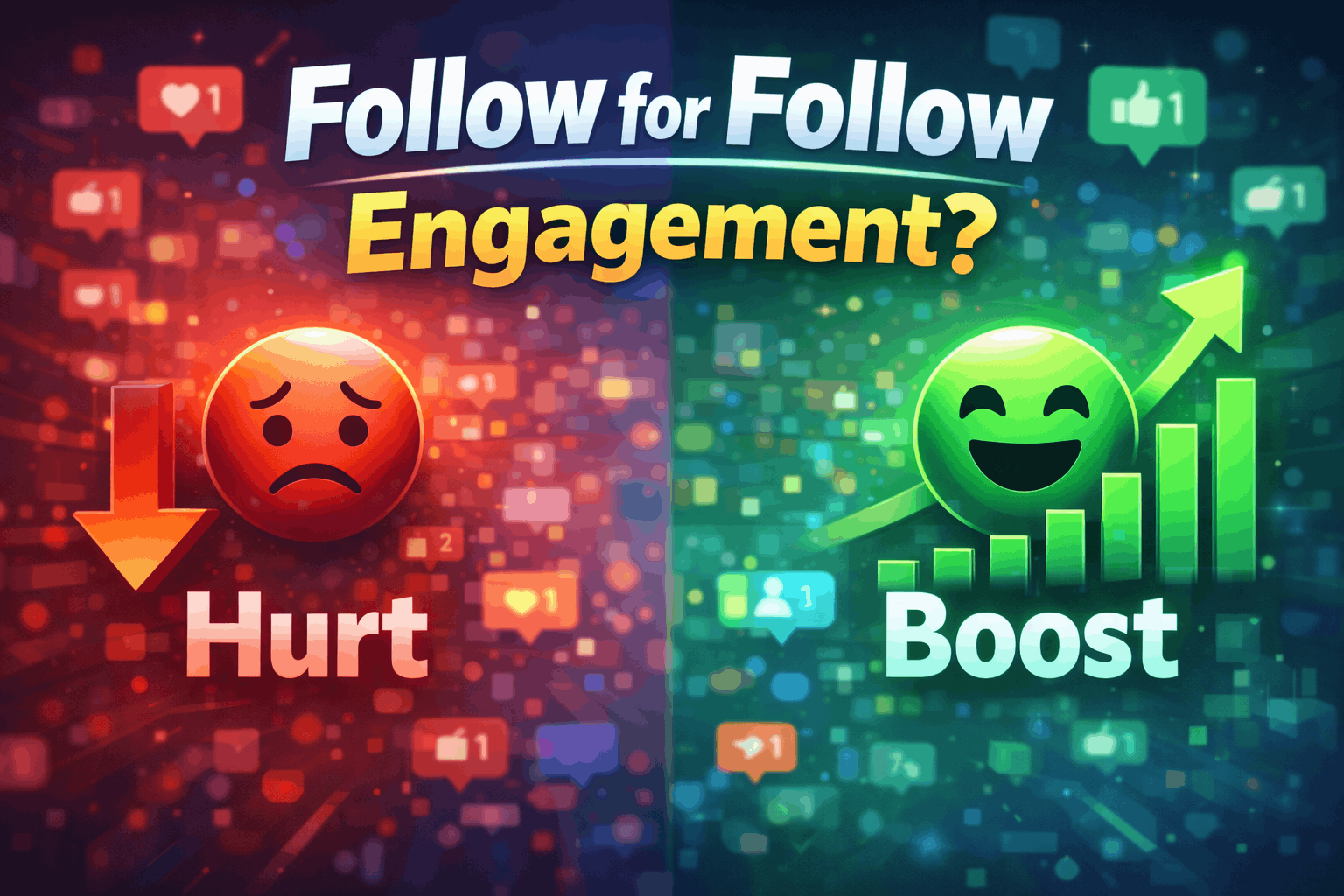
The real damage happens after the initial phase.
Once reciprocal behavior fades, posts are shown to an audience that isn’t genuinely interested. Scroll-through rates increase. Watch time drops. Saves and replies become rare. The system begins learning a pattern:
This content attracts followers, but fails to hold attention.
At that point, engagement doesn’t just stagnate—it erodes.
This is why creators often notice an engagement drop weeks or months after aggressive follow-for-follow activity. The tactic didn’t “break” engagement. It trained the algorithm on the wrong audience.
This pattern is discussed endlessly in forums and Reddit threads, but often misattributed to shadowbans or hidden penalties.
Follow for Follow Risks vs Shadowban Myths
One of the most persistent fears around follow for follow is the idea of being “shadowbanned.”
Creators notice a drop in reach or engagement and immediately assume they’ve been flagged, restricted, or secretly punished by the platform. Reddit threads, Discord groups, and comment sections are full of these stories—most of them drawing the wrong conclusion.
In reality, most engagement drops caused by follow for follow have nothing to do with shadowbans.
Modern platforms rarely need to suppress accounts manually. Hard restrictions are expensive, risky, and unnecessary in most cases. Instead, systems rely on probabilistic distribution. Content is shown, reactions are measured, and future distribution is adjusted accordingly.
If posts consistently underperform with an account’s own followers, the algorithm learns something simple: this audience is not a good match for this content.
Once that conclusion is reached, the system becomes more cautious. It tests new posts with smaller groups. It limits exploratory reach. It waits for stronger signals before expanding distribution.
From the creator’s perspective, this feels indistinguishable from a shadowban.
But nothing has been applied to the account.
No rules were broken.
No warnings were issued.
No visibility cap was enforced.
What changed is algorithmic confidence.
Follow for follow increases risk not because it violates policies, but because it manufactures large volumes of low-confidence connections. Each irrelevant follower slightly weakens engagement averages. Over time, those weak signals accumulate.
Eventually, the system stops taking chances.
This is why follow for follow is dangerous in a quiet way. It doesn’t trigger punishment. It triggers caution. And caution in recommendation systems looks like invisibility.
The myth of shadowbanning persists because it offers a clear villain. The real issue is less dramatic and more uncomfortable: the system is responding accurately to behavior.
Follow for follow doesn’t get you banned.
It gets you deprioritized.
And once distribution tightens, the only way back is rebuilding relevance—not waiting for a ban to “lift.”
The Real Pros and Cons of Follow for Follow
Follow for follow survives because it does deliver something. The problem is that what it delivers is rarely what creators actually need.
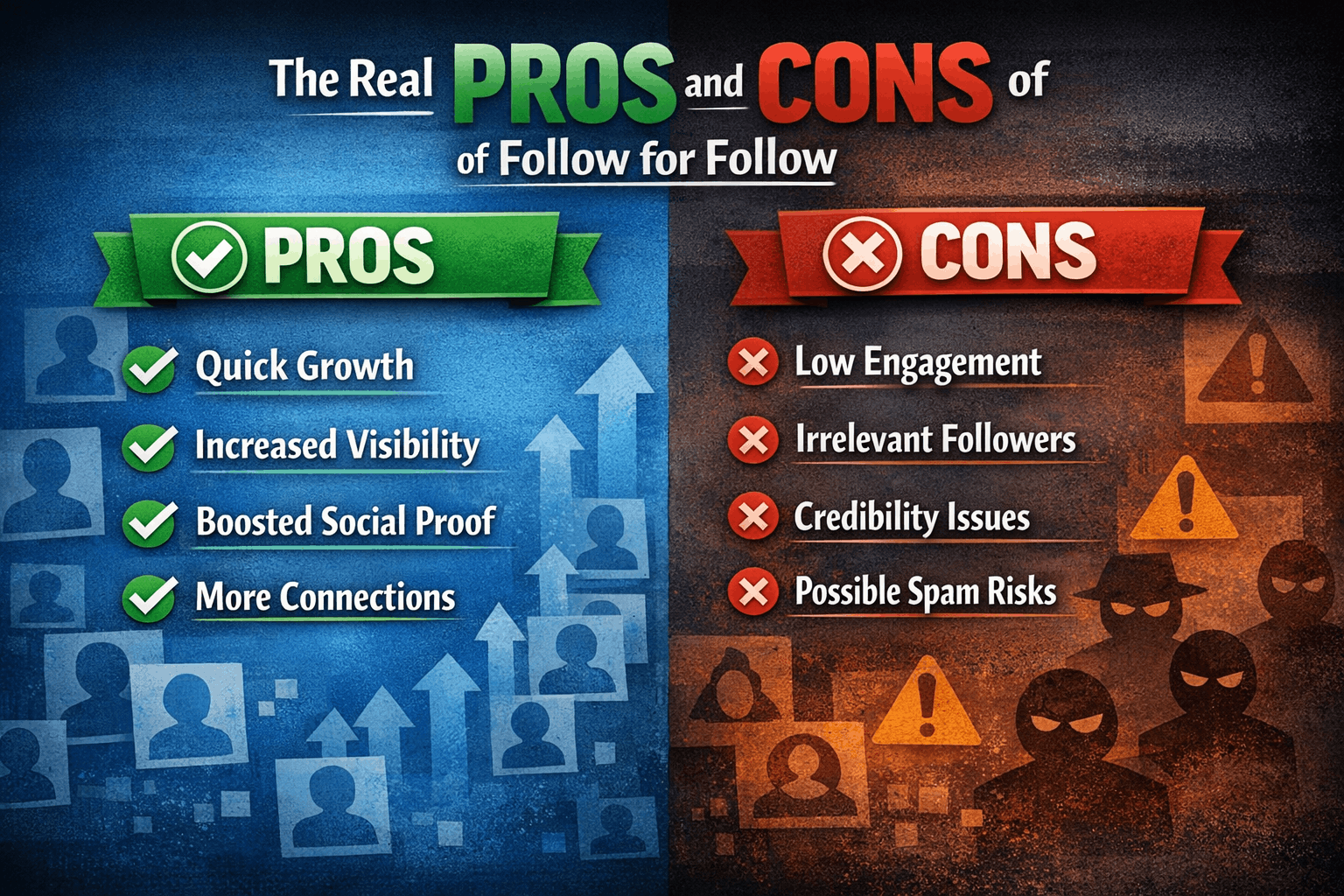
The Real Pros (And Why They’re Misleading)
It can increase follower count quickly.
This is the most obvious advantage, and the one people anchor on. Reciprocal follows still happen, especially in broad niches where attention feels transactional. For new accounts, watching numbers rise can feel like escaping the zero state.
It may create short-term activity on small accounts.
Early on, a few new followers might like a post or leave a surface-level comment. On accounts with minimal baseline engagement, this feels meaningful. The account appears more “alive,” both to the creator and to casual profile visitors.
It feels controllable during early growth.
Follow for follow offers a sense of agency. You take action, something happens. In an environment where organic reach feels opaque and unpredictable, that control is psychologically appealing.
But none of these benefits compound.
They are front-loaded, cosmetic, and fragile. And every one of them comes with a hidden cost.
The Real Cons (And Why They Compound)
Low engagement quality.
Most follow-backs are driven by obligation, not interest. That means engagement is shallow, inconsistent, or entirely absent after the initial interaction. Algorithms don’t just measure whether engagement happens—they measure how reliable it is.
Long-term reach suppression.
When content is repeatedly shown to followers who ignore it, the system reduces confidence in distribution. This doesn’t feel like a penalty, but it functions like one. Reach tightens. Testing slows. Discovery becomes conservative.
Audience mismatch.
Follow for follow builds an audience without a shared reason to exist. Different niches, different intents, different behaviors. When content goes out, only a small fraction is actually receptive. The rest become negative signals.
Slower discovery over time.
As signal quality drops, algorithms become less willing to introduce your content to new users. Growth doesn’t just plateau—it becomes harder than it was before you started.
This is why many creators feel like they “messed up” their engagement after doing follow for follow. Nothing dramatic breaks. The system just stops believing.
Follow for follow is not inherently evil or forbidden. It simply optimizes for the wrong metric.
Follower count goes up.
Engagement integrity goes down.
And in modern platforms, engagement integrity—not visible size—is what determines reach, discovery, and long-term growth.
That’s why follow for follow feels helpful early and harmful later. It solves a psychological problem, not a distribution one.
Growth that looks good but trains the algorithm to expect disengagement is not neutral. It’s expensive.
How Follow for Follow Can Boost Engagement (But Rarely Does) ?
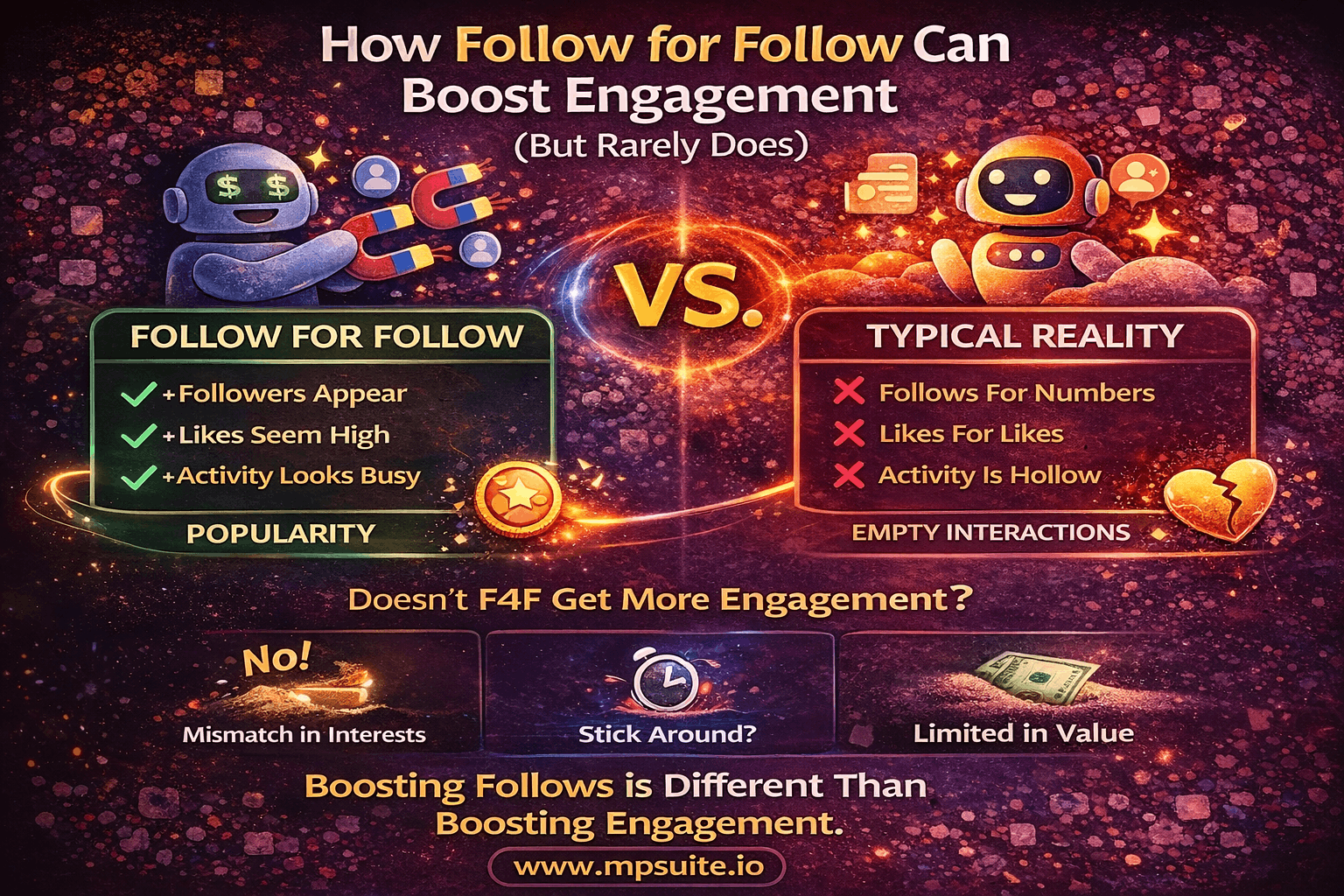
There are situations where follow-back behavior aligns with engagement—but they are far narrower than most people assume.
The only time follow for follow supports engagement is when relevance already exists before the follow happens. This typically appears in:
- Small, tightly defined niches
- Communities where creators already comment on each other’s content
- Peer networks where interaction precedes connection
In these cases, the follow is not the catalyst.
It’s the confirmation.
Engagement is already happening. Users are already watching, replying, or returning. The follow simply formalizes an existing relationship. From the algorithm’s perspective, nothing breaks—because behavior remains consistent after the follow.
This distinction is critical, and we break it down fully in the main follow for follow guide, because most creators reverse the order: they follow first and hope interest appears later.
That reversal is where things fall apart.
The moment follow for follow becomes the strategy—especially when scaled or automated—engagement begins to decay. Follows are no longer the result of relevance; they’re the substitute for it. Interaction becomes front-loaded, inconsistent, and short-lived.
Algorithms don’t penalize this directly. They simply stop trusting it.
What looked like engagement support becomes engagement drag.
Where Automation Fits Without Hurting Engagement ?
Automation itself is not the enemy.
Intent is.
Most automation tools fail because they automate the wrong stage of growth. They focus on discovery through volume—indiscriminate follows, mass actions, or reciprocal loops. This amplifies audience mismatch and accelerates the engagement problems associated with follow for follow.
Automation works only when it reinforces relevance after interest is demonstrated.
That’s the design philosophy behind MP Suite.
Instead of automating follow-for-follow loops, MP Suite focuses on post-discovery behavior: responding to demonstrated interest, reinforcing interaction, and helping creators stay present where alignment already exists. The goal is not to force engagement, but to support it once it starts.
When automation amplifies signals that already point in the right direction, engagement compounds.
When automation replaces intent, engagement collapses.
That line—between amplification and substitution—is the difference between sustainable growth and silent decay.
Follow for follow fails because it crosses that line.
Intent-aligned automation works because it doesn’t.
Final Takeaway
Follow for follow can create activity. It rarely creates engagement. In 2026, engagement isn’t about how many people follow you—it’s about how many people consistently respond.
If you want to understand why follow for follow once helped engagement and why that alignment broke, start with the pillar guide on follow for follow in 2026.
If you want to grow without sacrificing engagement quality, that’s the problem MP Suite was built to solve.