
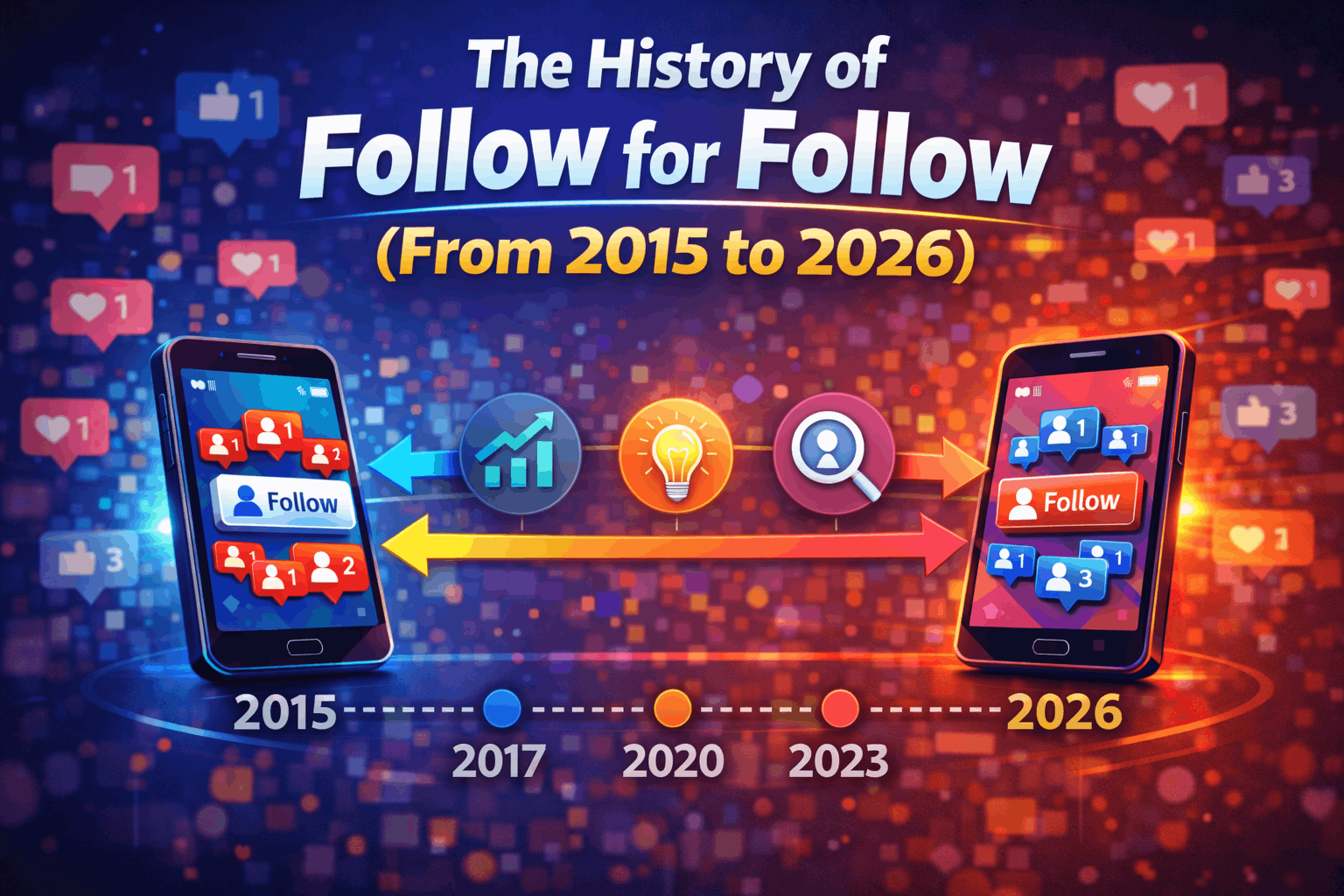
The history of Follow for Follow started around 2015, when platforms like Instagram and Twitter still relied heavily on follower count and early engagement to determine visibility. At that time, F4F was a manual tactic used by users to gain initial exposure by exchanging follows within hashtags, comments, and niche communities.
From 2015 to 2026, Follow for Follow evolved alongside social media algorithms, automation tools, and multi-platform marketing strategies. What began as a simple user behavior gradually became a structured growth method supported by automation and integrated growth systems. This article traces that evolution and explains why Follow for Follow continues to be used in modern social media marketing.
The Early Days of F4F (2015–2016)
In 2015, social media especially Instagram was still relatively open. Feeds were mostly chronological, discovery was limited, and follower count played a central role in perceived authority. Having more followers often meant more visibility, regardless of engagement quality.
This environment made Follow for Follow incredibly effective. Users manually searched hashtags, liked posts, left comments, and followed accounts in hopes of receiving a follow back. It was slow, but it worked. Every follow had a noticeable impact, and reciprocity rates were high.
At this stage, F4F was not seen as manipulation. It was seen as participation. Everyone was discovering the same growth constraints at the same time, and mutual follows felt like a fair exchange rather than a shortcut.
Early automation tools began to appear near the end of this period. They were basic, often unstable, but they revealed something important: growth actions could be systemized.
The Growth Hack Era (2017–2018)
As influencer marketing exploded, Follow for Follow moved from casual behavior to intentional strategy. Guides, tutorials, and growth communities formed around one core idea: follower momentum creates opportunity.
This period saw the rise of follow/unfollow bots, mass-action tools, and early growth agencies. Accounts could gain thousands of followers in weeks instead of months. For many users, this was their first exposure to automation as a growth multiplier.
However, volume came with side effects. Engagement rates began to drift away from follower counts. Accounts looked bigger than they performed. Platforms started collecting data on behavioral patterns, even if enforcement was still limited.
F4F did not decline during this era—it peaked. And in doing so, it forced platforms to respond.
Platform Crackdowns and Algorithm Shifts (2019–2020)
By 2019, social platforms began adjusting their algorithms aggressively. Instagram introduced stricter action limits, behavior analysis, and shadowbanning mechanisms. Twitter refined its spam detection. Automation that relied on raw volume started failing.
This period is often described as the “death” of Follow for Follow, but that narrative is misleading. What actually died was careless execution.
Marketers quickly learned that F4F still worked—but only when it adapted. Random targeting was replaced by niche relevance. Speed was replaced by pacing. Automation tools that mimicked human behavior outperformed those that chased scale.
Follow for Follow was no longer a hack. It became a controlled process.
The Rise of Smarter Automation (2021–2023)
As platforms matured, so did automation. Tools evolved from simple scripts into systems with logic, filters, and behavioral safeguards. Follow for Follow became one feature among many, rather than the entire strategy.
This era introduced interest-based targeting, delayed unfollow logic, activity scheduling, and cross-signal analysis. Automation started to resemble how real users behaved, only more consistent.
Marketers began using F4F as a support layer rather than a growth engine. It helped new accounts establish presence while content and engagement strategies handled retention and conversion.
The distinction between “bad bots” and “smart automation” became clear. One triggered penalties. The other blended into normal platform activity.
F4F in the Multi-Platform Era (2024–2025)
By 2024, growth was no longer confined to a single platform. Creators operated across Instagram, TikTok, X, Threads, and emerging networks simultaneously. Follow for Follow had to adapt again.
This is where multi-platform (MP) automation suites emerged as the dominant model. Instead of running isolated bots, marketers coordinated actions across accounts and platforms from a single system.
In this context, F4F became modular. It was activated when launching new profiles, testing content themes, or entering competitive niches. It was paused when organic signals took over.
Follow for Follow was no longer about chasing numbers—it was about timing.
Follow for Follow in 2026: What Changed?
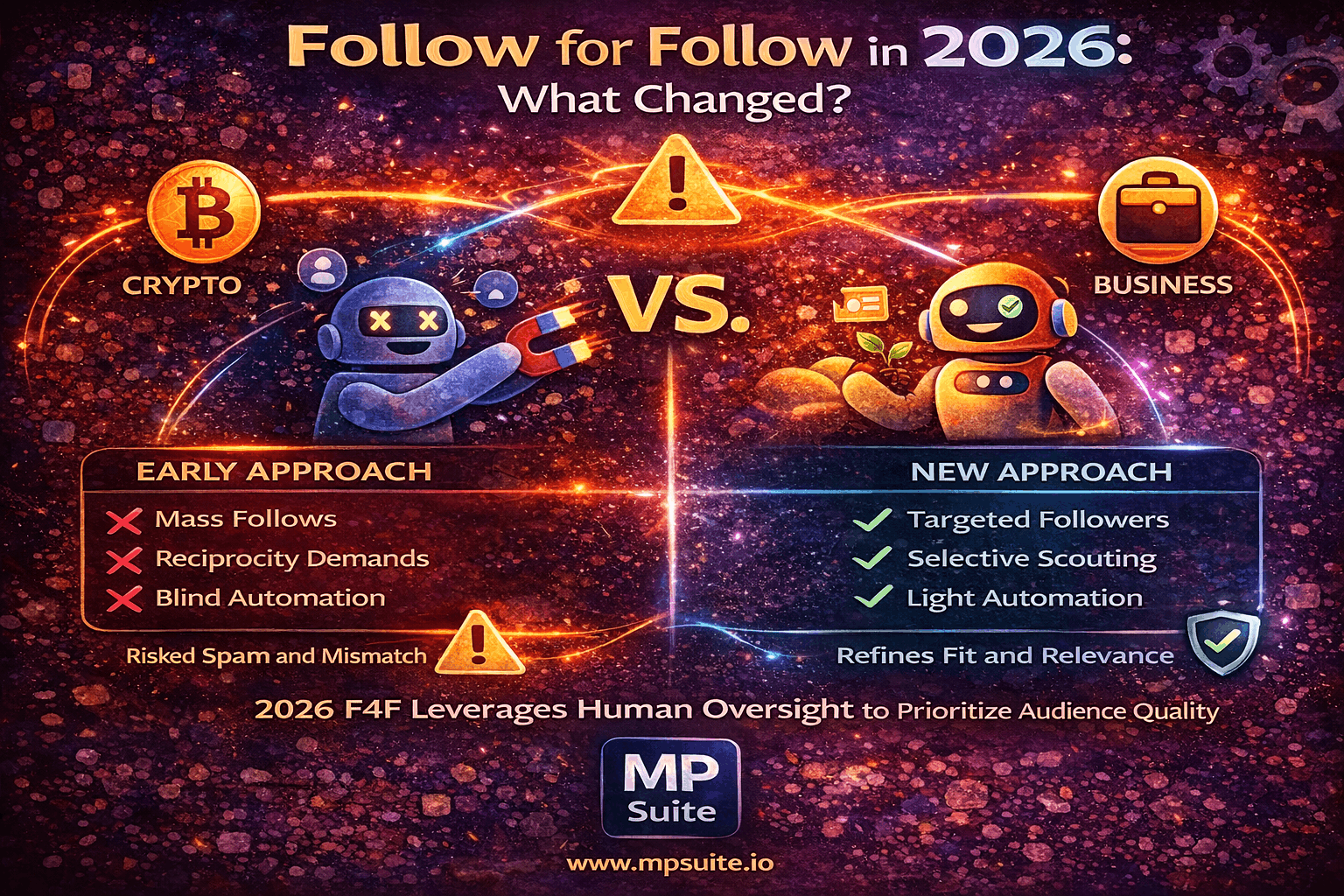
By 2026, social media algorithms are significantly more intelligent, but they are also more consistent in what they reward. Platforms can identify abnormal behavior patterns with high accuracy, yet they continue to rely on the same foundational signals: visibility, interaction, and network expansion.
What changed is not the importance of these signals, but how they are generated and interpreted.
Follow for Follow remains relevant because it solves a structural problem that has never been eliminated. New accounts still start with limited reach. New brands still lack social proof. New niches still require external validation before organic discovery becomes reliable. F4F accelerates these early-stage signals, allowing accounts to enter competitive environments faster.
In 2026, the role of F4F is no longer about accumulating raw follower numbers. It functions as a visibility initializer. By expanding network connections in a controlled way, F4F increases profile exposure, interaction opportunities, and algorithmic context without overwhelming the system.
Modern Follow for Follow is defined by precision. Targeting is based on niche relevance rather than volume. Actions are paced to reflect normal user behavior. Data from follow-back rates, engagement responses, and retention patterns inform ongoing adjustments. This feedback-driven approach makes F4F measurable instead of speculative.
Most importantly, F4F in 2026 does not operate alone. It is integrated into broader growth systems that include content strategy, engagement workflows, and multi-platform automation. Within these systems, F4F acts as an accelerator at specific moments—launch phases, market entry, or early scaling—rather than a permanent growth mechanism.
The shift from isolated tactics to integrated systems is what defines modern Follow for Follow. It is no longer a trick applied blindly, but a controlled process used with intent.
Why Follow for Follow Never Disappeared ?
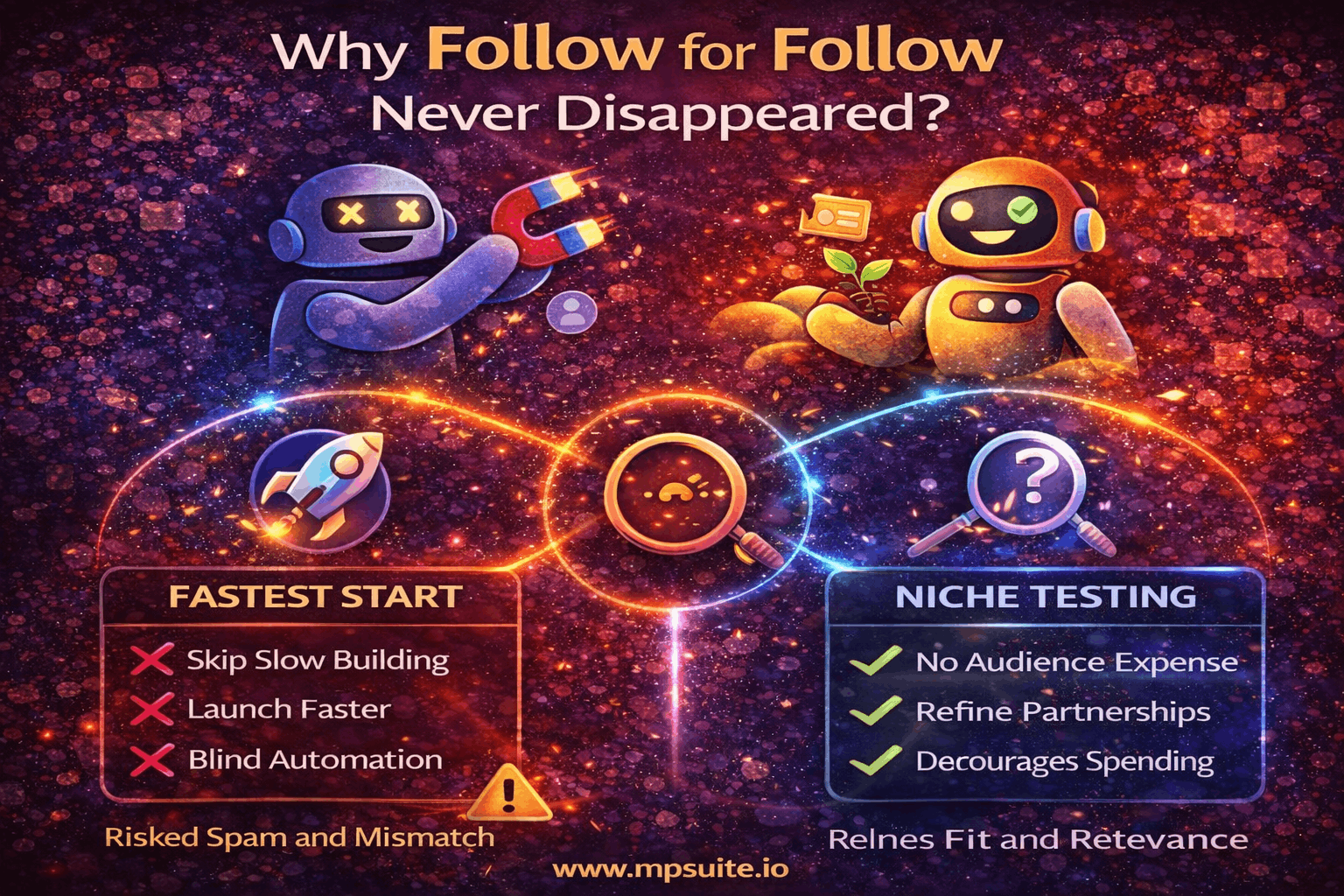
Follow for Follow has survived more than a decade of algorithm updates, policy changes, and shifting platform priorities because it is rooted in human behavior, not technical loopholes. Algorithms evolve, but the motivations that drive users to follow, reciprocate, and seek visibility remain consistent.
At its core, F4F leverages reciprocity. When one account follows another, it creates a low-friction social obligation to respond. This dynamic exists independently of platform rules and continues to function even as detection systems become more sophisticated. As long as social platforms are built around networks and connections, reciprocal behavior will persist.
Social proof is another reason F4F never disappeared. Follower count still influences how profiles are perceived—by users, brands, and even algorithms. A profile with visible momentum attracts attention more easily than one starting from zero. F4F provides a mechanism to create that momentum during early growth stages, when organic discovery is weakest.
Visibility is the third constant. New accounts face structural disadvantages: limited reach, minimal exposure, and no interaction history. Follow for Follow directly addresses this problem by expanding network connections, increasing profile visits, and generating early activity signals. These effects are subtle but cumulative, especially when applied with relevance and pacing.
What changed over time was not the concept, but the execution. Manual Follow for Follow methods gradually lost efficiency as platforms scaled and competition intensified. Automation filled that gap. As platforms adjusted their systems, automation adapted in parallel—introducing pacing, targeting, and behavior modeling that aligned more closely with normal user activity.
This continuous adaptation explains the cycle: platforms evolve, tools adapt, and F4F persists in a more refined form. Marketers who understand this history do not debate whether Follow for Follow still works. They focus on how it should be applied within current platform constraints.
From Growth Hack to Growth Infrastructure
The most important shift in the history of Follow for Follow is not technical, but conceptual.
In its early years, F4F was treated as a growth hack—a temporary trick used to exploit simple algorithms. As platforms matured, that mindset became outdated. Growth strategies moved away from isolated tactics toward integrated systems, and Follow for Follow evolved accordingly.
Today, F4F functions as growth infrastructure. It is no longer about maximizing short-term numbers, but about creating controlled acceleration at specific stages of an account’s lifecycle. When integrated into modern automation suites, F4F operates alongside content publishing, engagement tracking, and audience targeting rather than in isolation.
This integration changes the role of automation. Instead of overwhelming platforms with volume, modern tools emphasize consistency, relevance, and timing. Follow actions are paced, unfollow logic is delayed, and targeting is refined to match real audience segments. The result is sustainable momentum without disrupting long-term strategy.
Modern tools reflect evolution, not rebellion. They are built around how platforms actually function, not how they once did. Follow for Follow did not survive by resisting change—it survived by adapting to it.
Final Thoughts on the Evolution of F4F
From 2015 to 2026, Follow for Follow evolved alongside social media itself. It adapted to new rules, new algorithms, and new expectations. What remained constant was its purpose: helping accounts gain momentum in competitive environments.
Those who dismiss F4F entirely misunderstand its role. Those who use it blindly misuse it. The advantage belongs to those who understand its history—and apply it accordingly.
In modern social media growth, strategy determines outcome. Follow for Follow is simply one of the tools available to those who know how to use it.