
Follow for follow is one of those tactics that refuses to disappear.
No matter how much social media evolves, no matter how sophisticated algorithms become, people still ask the same question every year: Does follow for follow still work? And in 2026, that question hasn’t gone away—it has simply become more confused.
As builders in the social growth space, we’ve watched follow for follow go through multiple cycles: hype, backlash, quiet use, and revival under new names. The problem isn’t that people are curious about it. The problem is that most people are asking the wrong question.
This article exists to reset the conversation.
Not to praise follow for follow.
Not to dismiss it with clichés.
But to explain what it actually is, why it once made sense, why it mostly fails today, and what replaced it.
What Follow for Follow Actually Means ?
At its most basic level, follow for follow means exactly what the name implies: you follow someone with the expectation that they will follow you back. It is not a growth strategy by itself—it is a reciprocal behavior.
That distinction matters.
When people talk about follow for follow as a “hack” they’re usually talking about volume. How many people can I follow today? How many will follow me back? How fast can I inflate my numbers?
But follow for follow was never designed to solve reach, engagement, or influence. It solved something much simpler: early visibility.
In the early days of social platforms, having followers—even inactive ones—created perceived legitimacy. Accounts with higher follower counts were treated as more important by both users and algorithms. Follow for follow emerged naturally in that environment, not as manipulation, but as adaptation.
Where Follow for Follow Came From ?
To understand whether follow for follow still works in 2026, you have to step back into a version of social media that no longer exists.
Early platforms were not designed to predict interest. They were designed to display activity. Feeds were chronological, not ranked. If you followed someone, you saw what they posted—simple as that. Discovery systems were shallow, often limited to hashtags, basic search, or “recent activity.” Engagement signals existed, but they were weak, slow, and secondary.
In that environment, a follow was not just a symbolic action. It was a distribution trigger.
Every new follower increased the probability that your content would be seen. Not recommended. Not boosted. Simply shown. And when content is shown, engagement follows naturally—even if interest is marginal.
This is why follow for follow wasn’t originally viewed as manipulation. It was closer to networking. People followed each other because visibility was scarce, and mutual following solved that scarcity.
There was also a strong psychological layer. Early social media rewarded visibility over quality. Accounts with higher follower counts were perceived as more credible by users and algorithms alike. This created a feedback loop: visibility led to followers, followers led to more visibility.
For new accounts, this mattered enormously. The cold start problem was brutal. Without followers, content died silently. Follow for follow offered a way to escape that dead zone.
And here’s the most important part: the algorithm allowed it.
Not because it was naive, but because it was aligned with the platform’s goals at the time. Platforms wanted more connections, more activity, more growth. Follow for follow produced all three.
It didn’t trick the system. It worked with the system.
That’s why it scaled so fast. And that’s why it lasted as long as it did.
But systems evolve.
Why That Alignment Broke ?
As platforms matured, their priorities shifted. Growth was no longer about raw activity. It became about retention, satisfaction, and relevance.
Chronological feeds gave way to ranked feeds. Discovery moved from “recent” to “recommended.” Algorithms stopped asking who follows whom and started asking who actually cares.
This was the breaking point for follow for follow.
Once platforms began measuring outcomes instead of actions—watch time instead of views, saves instead of likes, repeated interactions instead of one-off engagement—the value of a follow changed completely.
A follow stopped being a distribution guarantee and became a hypothesis: Will this user care about this content?
Follow for follow produces a very weak hypothesis.
How Follow for Follow Is Practiced Today ?
Modern follow for follow looks nothing like its original form.
It is rarely two creators discovering shared interests and deciding to stay connected. Instead, it is usually mechanical, scaled, and detached from relevance. Accounts mass-follow hundreds of users per day hoping for reciprocation. Comments like “F4F” or “Followed” are dropped indiscriminately. Private groups coordinate mutual following. Automated systems run follow–unfollow cycles designed to maximize numbers with minimal effort.
What changed is not just execution—it’s intent.
The intent is no longer connection. It’s extraction.
And modern algorithms are extremely good at detecting intent through behavior.
These actions generate highly consistent patterns: abnormal follow ratios, short dwell times, low engagement after follow, rapid unfollow cycles. Individually, none of these signals are damning. Together, they form a profile that clearly indicates non-organic behavior.
This is where follow for follow collapses.
What once looked like networking now looks like noise because it no longer produces the signals platforms are optimized to reward. There is no sustained interest. No content alignment. No behavioral confirmation.
From the algorithm’s perspective, these connections add friction, not value.
And friction is punished—not through bans, but through invisibility.
The Key Shift Most People Miss
The most important change is not enforcement. It’s interpretation.
Platforms no longer care what you do. They care what happens after.
You can still follow people. People can still follow you back. But if those follows don’t lead to meaningful interaction, the system learns quickly that the connection is irrelevant.
That’s why follow for follow feels “allowed” but stops working.
The tactic survived.
The context died.
Does Follow for Follow Work in 2026?
Whether follow for follow works in 2026 depends less on the tactic itself and more on what you expect the outcome to be.
If “work” means watching your follower count increase, then yes—follow for follow still delivers. People continue to reciprocate follows, especially in crowded niches where attention feels transactional. Numbers rise. Profiles look bigger. At a glance, growth appears to be happening.
But this definition of “work” is shallow, and platforms stopped optimizing for shallow outcomes a long time ago.
Modern social systems don’t reward presence; they reward response. They don’t care how many people follow you—they care how people behave after they follow you. Do they stop scrolling? Do they watch? Do they interact? Do they come back?
Follow for follow almost never produces those behaviors.
This is where most creators unknowingly sabotage themselves. They anchor their sense of progress to the most visible metric available, because visibility feels like certainty. You can open your profile and see follower count instantly. You cannot see algorithmic trust. You cannot see audience relevance. You cannot see how many people the system quietly stopped testing your content with.
Those metrics exist—but they’re invisible.
Algorithms, however, don’t operate on what’s visible. They operate on what’s predictive.
When someone follows you out of reciprocity rather than interest, the algorithm treats that follow as a weak signal. It waits for confirmation. That confirmation comes in the form of behavior: watch time, saves, replies, repeat interactions. When those signals don’t arrive, the system revises its assumptions.
Do this at scale, and you train the algorithm to expect disappointment.
This is why follow for follow often feels like it “works” at first and then inexplicably stops working later. Early on, the system still tests your content. It gives you chances. But as mismatched followers accumulate, test results worsen. Reach contracts. Discovery slows. Growth becomes harder, not easier.
Creators rarely connect these dots.
Instead, they blame content quality, posting time, hashtags, or platform bias. In reality, the algorithm is behaving logically. It is responding to an audience that was never interested in the first place.
So does follow for follow work in 2026?
It works if your goal is to look bigger.
It fails if your goal is to be seen more.
And in an environment where reach is earned through relevance, not reciprocity, looking bigger without being relevant is not neutral—it’s actively harmful.
Follow for follow doesn’t break the algorithm. It teaches the algorithm the wrong lesson.
The Engagement Mismatch Problem
At the core of why follow for follow fails in modern social systems is a simple but uncomfortable truth: a follow does not equal interest.
Platforms stopped treating a follow as a vote a long time ago. Today, it is closer to a weak introduction—an opportunity for the algorithm to test whether a relationship is real or accidental. What determines the outcome of that test is not the follow itself, but what happens afterward.
When someone follows you out of reciprocity, they are not signaling curiosity about your content. They are fulfilling a social expectation. The motivation is external, not intrinsic. That distinction matters because algorithms are built to detect intrinsic interest through behavior, not intent.
When your post appears in that follower’s feed and they scroll past it without slowing down, the system registers that response. When they don’t watch the video, don’t tap the caption, don’t interact in any meaningful way, the algorithm records another data point. Individually, these moments are insignificant. At scale, they become decisive.
This is where engagement mismatch begins.
Your content is being shown to people who were never meant to see it. Not because your content is bad, but because the audience is wrong. The algorithm doesn’t know why the mismatch exists—it only sees the outcome. And the outcome tells a consistent story: exposure without response.
Over time, the system stops offering your content to those users. But it doesn’t stop there. It also becomes less willing to test your content with new audiences, because past tests have produced weak results. In algorithmic terms, your content becomes a low-confidence candidate.
This is why creators who rely on follow for follow often feel like they’re shouting into a void. Their audience size grows, but their influence shrinks. Posts reach fewer people. Discovery stalls. Momentum disappears.
From the creator’s perspective, this feels like punishment. From the platform’s perspective, it’s optimization.
The algorithm isn’t enforcing morality or fairness. It’s minimizing wasted impressions. Showing content to people who repeatedly ignore it is inefficient. So the system reallocates attention elsewhere.
What makes the engagement mismatch problem especially dangerous is that it compounds silently. Every irrelevant follower slightly lowers the average probability of engagement. Lower probabilities lead to fewer tests. Fewer tests lead to slower growth. By the time creators notice something is wrong, the damage has already been normalized.
This is why “more followers” can become a liability instead of an asset.
The algorithm is not hostile to growth. It is hostile to irrelevance.
And follow for follow, when scaled without intent, produces irrelevance by design.
Follow for Follow Results in the Real World ?
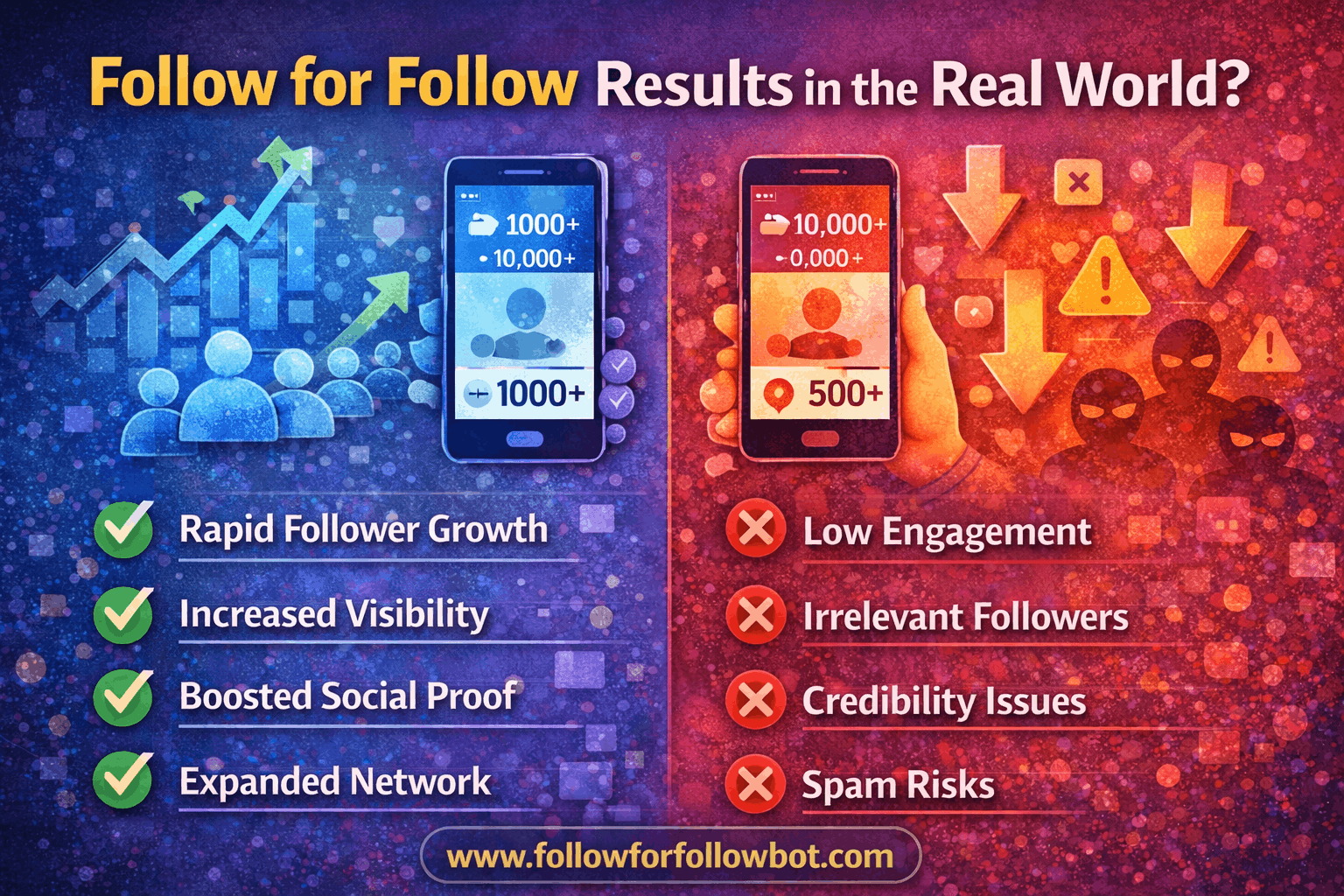
In real-world usage, follow for follow rarely fails immediately. That’s part of why it’s so convincing.
The first phase almost always feels like success. Follower count rises quickly. Notifications are active. Profiles look more established. For creators who have been posting into silence, this moment feels like momentum. Something is finally moving.
But this phase is deceptive.
What follows is not a crash, but a slow erosion. Engagement rate begins to slip—not dramatically, but enough to be noticeable. Posts that once reached a modest percentage of followers now reach fewer. Discovery feels inconsistent. Some content performs, most doesn’t.
This is when creators start to panic quietly.
Because nothing obvious is “broken.” Content is still being posted. Effort is still being applied. From the outside, the account looks larger than before. But internally, performance metrics tell a different story.
This is where misdiagnosis begins.
Most creators assume the problem must be content-related. They post more frequently. They change formats. They chase trends. They tweak captions, hashtags, posting times. Each adjustment feels rational, but none address the underlying issue.
The real problem is structural, not creative.
Follow for follow builds an audience that does not share a common interest. It mixes people from different niches, motivations, and behaviors into one follower pool. When content is published, only a small fraction of that pool is actually receptive. The rest are passive observers—or worse, disengaged signals.
Over time, the algorithm adapts to this reality. It learns that testing your content broadly produces weak results. So it tests less. Reach contracts. Discovery becomes conservative. Growth slows even as effort increases.
From the creator’s perspective, this feels unfair. From the system’s perspective, it is efficient.
The most damaging part is that this decline rarely feels dramatic enough to trigger immediate course correction. Accounts don’t collapse. They plateau. They stagnate. They become harder to grow than they were before follow for follow was introduced.
This is why growth becomes harder, not easier.
Relevance has been diluted. Trust has been weakened. Not because the creator did anything malicious, but because the audience was assembled without intent.
Growth without relevance doesn’t just fail to help. It actively teaches the algorithm to lower its expectations of your content.
And once that expectation is lowered, rebuilding trust takes far longer than building numbers ever did.
Tips: Common Follow for Follow Mistakes to Avoid
Is Follow for Follow Allowed?
This is where most conversations around follow for follow go wrong, because people frame the question in legal terms instead of systemic ones.
Most platforms do not explicitly ban the act of following someone and receiving a follow back. On the surface, that behavior looks normal. People follow each other all the time for legitimate reasons: shared interests, networking, community building. If platforms banned reciprocity outright, they would break social interaction itself.
But platforms don’t govern intent. They govern patterns.
What they restrict is not the idea of follow for follow, but the behaviors that usually accompany it when people try to scale it: excessive actions in short time windows, repetitive follow–unfollow cycles, automation footprints, and engagement patterns that don’t lead to meaningful interaction.
This is why follow for follow feels “allowed” right up until it isn’t.
Creators assume that if there is no explicit rule against something, it must be safe. But modern moderation systems don’t work on yes-or-no rules alone. They work on probability and risk modeling. They look at how an account behaves compared to normal human usage, and how other users respond to that behavior.
Follow for follow becomes dangerous not because of the follow, but because of what usually follows it: a trail of weak engagement signals, short-lived connections, and behavior that scales faster than genuine interest ever could.
At that point, the system doesn’t need to take punitive action. It simply adjusts distribution.
Reach declines. Discovery slows. Content is tested less aggressively. From the creator’s point of view, this feels like a penalty. From the platform’s point of view, it’s just risk reduction.
No rule has to be broken for this to happen.
That’s the uncomfortable truth most people miss: you can stay technically “within the rules” and still lose algorithmic trust.
The danger isn’t the tactic itself.
The danger is the behavioral fingerprint it leaves behind.
Why Platforms Don’t Like Follow for Follow ?
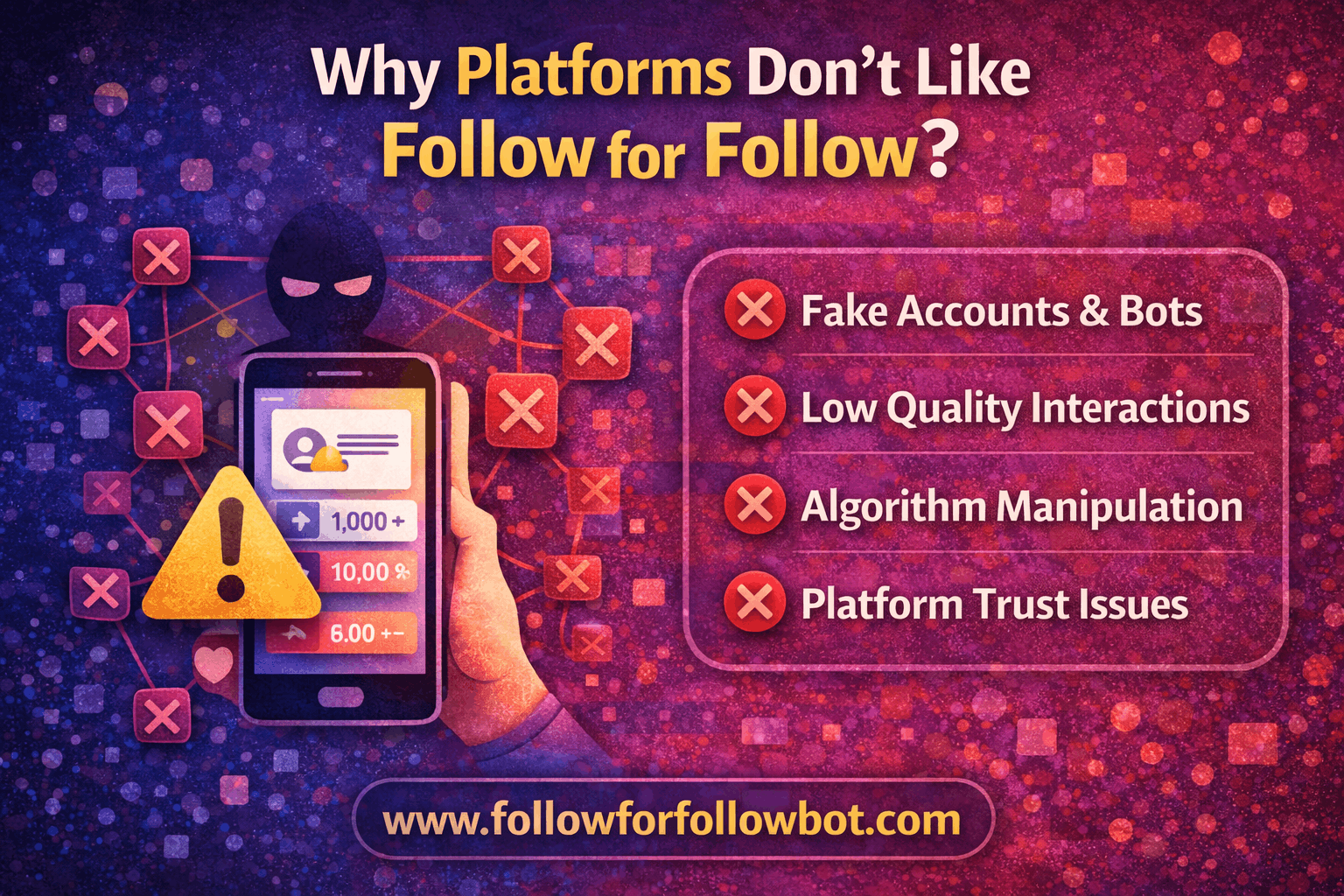
To understand why platforms quietly deprioritize follow for follow behavior, you have to understand their core objective.
Platforms are not anti-growth. They want creators to grow, audiences to expand, and content to circulate. Growth keeps ecosystems alive. What platforms are deeply allergic to is friction.
Friction happens when content is shown to the wrong people.
Every time a user is presented with content they don’t care about, the platform risks dissatisfaction. Scroll fatigue increases. Time spent decreases. Prediction accuracy weakens. Recommendation systems become noisier.
Follow for follow introduces exactly this kind of noise.
It connects accounts based on obligation rather than interest. From the system’s perspective, these connections are low-confidence. They don’t reliably predict future behavior. When large numbers of these weak connections exist, the recommendation engine has a harder time answering its most important question: Who should see this next?
Platforms don’t need to judge whether follow for follow is ethical or fair. They only need to observe that it reduces signal quality.
And when signal quality drops, systems compensate by becoming more conservative. They test content with smaller groups. They reduce exploratory distribution. They favor accounts with clearer audience alignment.
This is why follow for follow doesn’t need to be banned to be ineffective.
It works against the platform’s goal of relevance at scale.
Platforms optimize for satisfaction, not reciprocity. Any behavior that prioritizes numbers over relevance creates friction. And friction, in algorithmic systems, is quietly filtered out.
That’s why follow for follow fades not through punishment, but through invisibility.
What Actually Works Instead of Follow for Follow ?
Once you understand why follow for follow fails, the next question becomes unavoidable: what replaces it?
The answer is not “no growth tactics at all.” And it’s definitely not “just post better content,” even though content quality matters. The real shift is more subtle.
Modern growth isn’t about forcing connections. It’s about helping the algorithm discover the right audience faster.
That requires three things working together: intent, behavior, and scale.
Intent means you’re interacting with users who are already showing interest in content like yours. Behavior means those interactions look natural, consistent, and human. Scale means you can repeat this process without burning hours every day or triggering platform defenses.
This is where most creators get stuck.
Manually, intent-based growth is painfully slow. You can find relevant profiles, engage thoughtfully, and build real connections—but only a handful per day. On the other hand, traditional automation tools focus on volume, not relevance. They replicate follow for follow at scale, which just recreates the same problems faster.
We built MP Suite specifically to sit between those two extremes.
Why We Built MP Suite (And Why It’s Not a Follow-for-Follow Tool)?
As a team, we didn’t set out to build another follow-for-follow engine. We’ve seen what those do to accounts over time. Inflated numbers, collapsing reach, and creators blaming themselves for algorithmic outcomes they don’t fully understand.
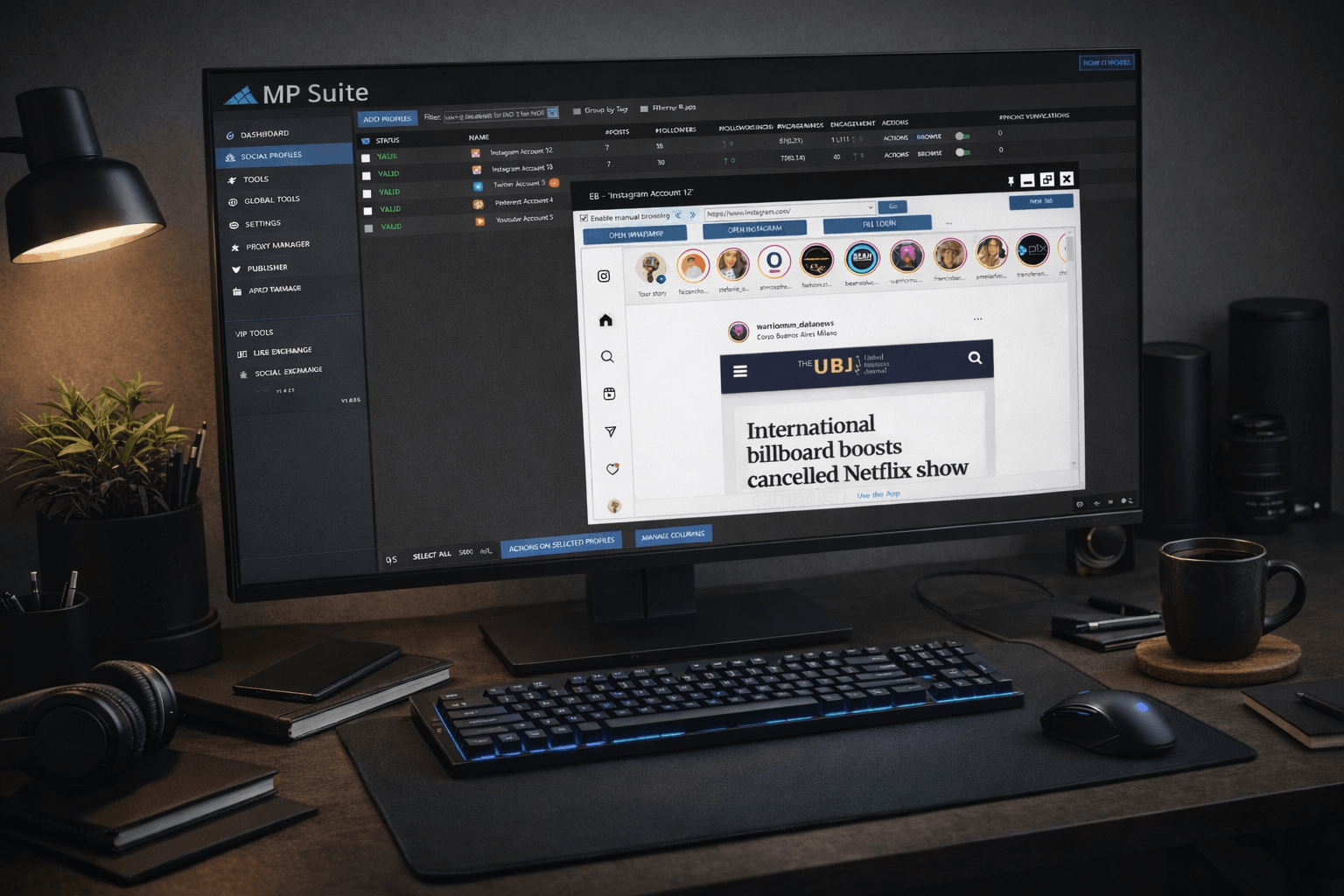
MP Suite was designed around a different premise:
automation should amplify relevance, not replace judgment.
Instead of mass-following random users and hoping for reciprocity, MP Suite focuses on behavioral targeting. It helps identify users who are already engaging with specific niches, content types, or interaction patterns. The goal isn’t to get a follow back—it’s to trigger interest.
That distinction changes everything.
When interactions are aligned with genuine interest, follow-backs become a byproduct, not the objective. More importantly, engagement after the follow actually happens. The algorithm sees continuity instead of drop-off. Signals strengthen instead of decay.
This is the opposite of follow for follow.
From Reciprocity to Relevance
Follow for follow is built on reciprocity: I followed you, now you owe me. MP Suite is built on relevance: this content is for you.
Algorithms don’t respond to obligation. They respond to behavior.
By focusing on users who are already likely to care, MP Suite helps creators avoid the engagement mismatch problem entirely. Fewer followers are wasted. Fewer impressions are ignored. Trust compounds instead of eroding.
This is why accounts using relevance-first systems tend to grow slower at the very beginning—but faster and more sustainably over time.
Growth stops being noisy. Signals get cleaner. Discovery improves.
The Role of Automation in 2026
Automation isn’t the enemy. Blind automation is.
In 2026, the question isn’t whether to automate, but what exactly you’re automating. Repeating outdated tactics faster only accelerates failure. Scaling intent-based behavior, on the other hand, does what manual growth can’t: it gives algorithms enough data to understand who your content belongs to.
That’s the role MP Suite plays inside a modern growth strategy.
Not as a shortcut.
Not as a hack.
But as infrastructure.
The Myths That Keep Follow for Follow Alive
Follow for follow survives not because it works, but because it feels good.
It creates the sensation of progress in an environment where real growth is slow, uncertain, and largely invisible. Numbers move. Notifications appear. The account looks bigger. That surface-level feedback is powerful—especially when organic reach feels unpredictable and out of the creator’s control.
This is the first myth: that visible growth equals real momentum.
Follower count is easy to see. Influence is not. Influence shows up in attention, repeat engagement, and behavioral depth—signals most creators never see directly, but algorithms track relentlessly. When these signals are weak, a larger audience doesn’t amplify results. It dilutes them.
The second myth is that follow for follow can be “fixed later.”
Creators assume they can inflate numbers early and refine the audience afterward. In practice, algorithms don’t reset cleanly. Early interaction patterns shape how systems test and distribute content long-term. Weak signals don’t disappear—they accumulate.
By the time creators try to course-correct, the system has already learned what to expect from their content.
This is why shortcuts rarely stay short.
What feels like acceleration at the beginning often becomes drag later—not because the tactic was punished, but because it trained the algorithm on the wrong audience from day one.
What Actually Changed And Where Follow-Back Still Makes Sense ?
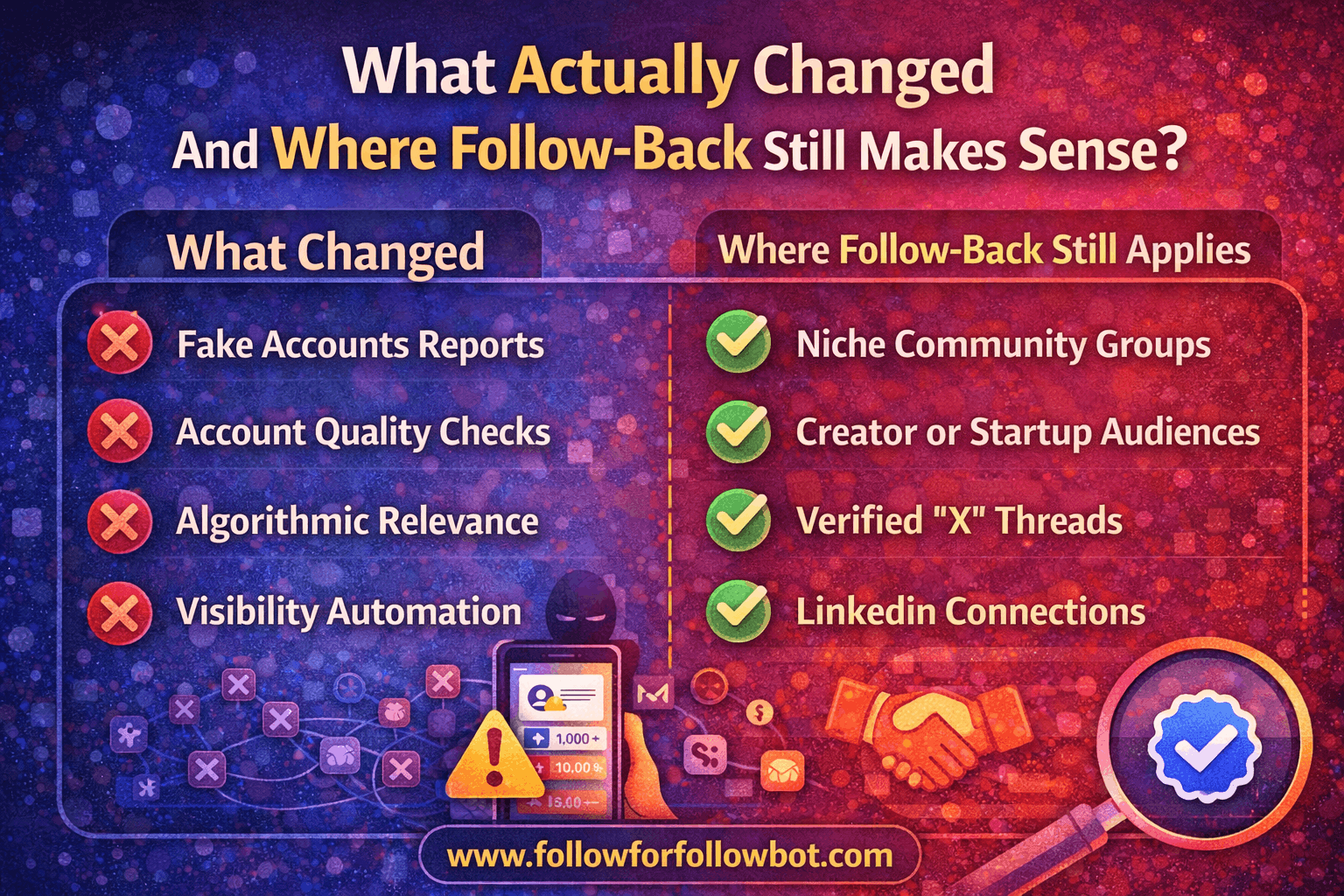
The most important shift in 2026 is not stricter enforcement. It’s smarter interpretation.
Modern algorithms no longer evaluate isolated actions. They evaluate outcomes. They don’t care that a follow happened—they care about what happened after. Did the user stop scrolling? Did they watch, engage, or return? Behavior, not intention, is now the primary signal.
This is why reciprocal tactics lost their effectiveness. Follow for follow fails not because it is forbidden, but because it produces weak post-follow behavior. The system sees connections without confirmation. Interest without response. Exposure without attention.
What replaced it is not “no growth tactics,” but intent-based discovery.
Growth now comes from connecting with users who are already demonstrating interest in similar content—through what they watch, save, comment on, and repeatedly engage with. Relevance, not obligation, is what triggers distribution.
This shift is subtle, but decisive.
At the same time, this does not mean that follow-back behavior is inherently wrong.
There are still contexts where mutual following is natural and healthy: small communities, niche industries, early-stage networking, or genuine peer relationships. In these cases, the follow-back is not the strategy—it is a byproduct of shared relevance.
The moment follow for follow becomes the goal rather than the outcome, it stops working.
That distinction is what separates organic growth from algorithmic friction in 2026.
Tips: Follow for Follow vs. Organic Growth – Which One Wins?
What Replaced Follow for Follow ?
Follow for follow didn’t disappear because platforms banned it. It faded because something more effective took its place.
Modern growth is no longer driven by connections alone, but by signals. Platforms now optimize around what people actually do: how long they watch, what they save, who they reply to, which profiles they return to, and how consistently interest is sustained over time.
These signals are what algorithms trust.
As a result, growth systems evolved. The focus shifted away from manufacturing numbers and toward amplifying relevance. The goal is no longer to accumulate followers, but to help the algorithm understand who your content is for as quickly and accurately as possible.
This is where automation quietly changed roles.
Used blindly, automation just scales old mistakes. It accelerates follow for follow, multiplies engagement mismatch, and leaves a behavioral footprint that systems learn to avoid.
Used intelligently, automation does the opposite. It supports intent-based discovery. It helps creators interact at scale with users who are already demonstrating interest in similar content—through what they engage with, not who they follow.
That distinction is everything.
This is the gap we built MP Suite to fill.
Not as a follow-for-follow engine, and not as a growth hack, but as infrastructure for relevance-first automation. A system designed to help creators scale the right behaviors, so the signals they send to platforms remain clean, consistent, and aligned with real interest.
Automation isn’t the advantage. Alignment is.
Final Verdict: Does Follow for Follow Still Work in 2026?
Follow for follow still works if your only objective is to make numbers go up. It does not work if your goal is reach, engagement, influence, or long-term visibility. The tactic isn’t malicious. It’s outdated.
Growth in 2026 isn’t powered by reciprocity. It’s powered by relevance—by how accurately your content matches the people who see it, and how they respond when it does.
Relevance can’t be traded. It can’t be forced. And it can’t be automated carelessly.
But it can be identified, supported, and scaled. That’s the shift that replaced follow for follow—and the line we’ve chosen to build on.